Here’s a number that should make every HVAC business owner stop and think: 97% of people search online before calling a local service business (BrightLocal, 2024). If your HVAC company isn’t showing up in those local searches, someone else is getting that call — and that revenue.
I’ve worked with dozens of service businesses on local SEO, and HVAC is one of the most competitive niches out there. You’re competing with big national brands, regional chains, and your neighbour down the street who just figured out Google. The good news? Most HVAC companies are still doing local SEO wrong — which means getting it right gives you a massive advantage.
In this guide, I’ll walk you through exactly how local SEO for HVAC works in 2026 — from setting up your Google Business Profile to building the kind of online reputation that turns searches into signed contracts.
What you’ll learn: How to rank in Google’s Local Pack, get more reviews, build location pages, and turn your website into a lead machine. all without a huge budget.
Why Local SEO Matters More for HVAC Than Almost Any Other Industry
Think about when someone calls an HVAC company. Their AC stopped working in the middle of July. Their furnace went out overnight. They need someone NOW. They’re not browsing Pinterest or reading reviews for a week — they type “AC repair near me” and they call the first credible business they see.
That’s the HVAC buyer’s journey: Search → Click → Call. And it often happens within minutes.
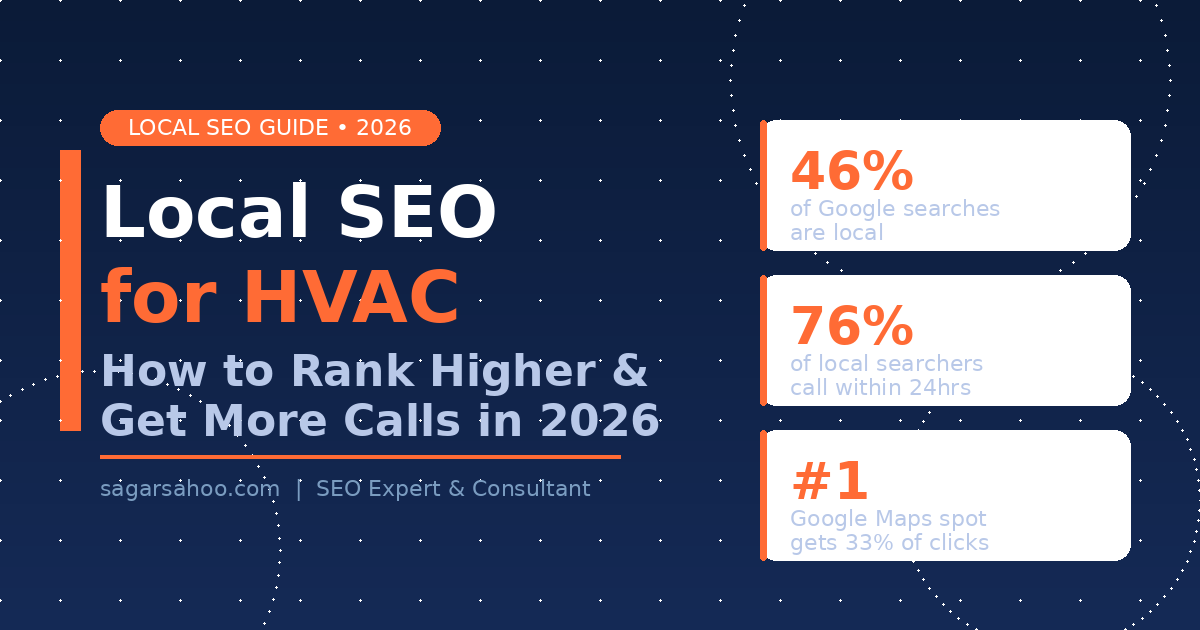
According to Google’s own data, 76% of people who search for a local service on mobile visit or call that business within 24 hours. For HVAC, that number is likely even higher because it’s almost always an urgent need. Local SEO for HVAC isn’t a nice-to-have — it’s how you get found at the exact moment a customer is ready to pay.
Case Study: A residential HVAC company in Texas (shared by BrightLocal) went from page 3 on Google to the Local Pack top 3 within 4 months of optimising their Google Business Profile and building consistent citations. Their inbound calls increased by 67% in the first summer season.
Step 1: Your Google Business Profile Is Your Most Powerful SEO Tool
When someone searches “HVAC repair [your city]” the first thing they see isn’t your website. It’s the Local Pack, that map with three business listings at the top. Getting into that box is Google Business Profile (GBP) optimisation.
Here’s what most HVAC companies get wrong: they create a GBP listing, add their phone number, and leave it. That’s like opening a shop and never putting up a sign. Here’s what complete GBP optimisation actually looks like:
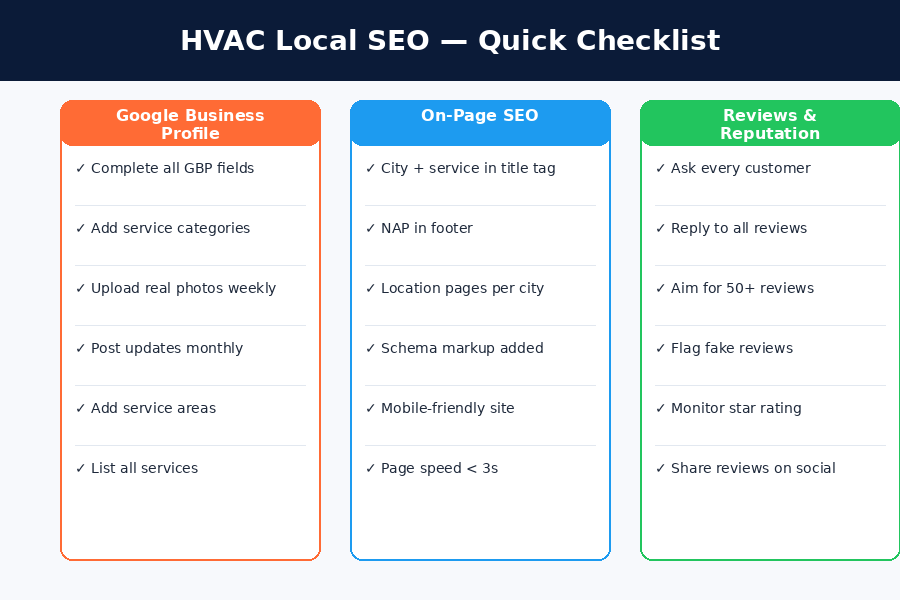
- Choose the right primary category use “HVAC Contractor” (not just “Air Conditioning”)
- Fill every single field: business description, service areas, hours, website URL, phone
- Add real photos — your vans, your team, completed jobs. Listings with 10+ photos get 35% more clicks (Google, 2023)
- List every service separately: AC installation, furnace repair, duct cleaning, etc.
- Post weekly updates — seasonal offers, tips, or a recent customer job
- Answer every question in the Q&A section before customers even ask them
GBP is also where Google looks to verify you’re a real, active business. An incomplete or stale profile tells Google — and your potential customers — that you’re not the most reliable option.
Step 2: On-Page SEO — Your Website Has to Work for Your City, Not Just Your Brand
Your website is the second signal Google uses to decide if you should rank locally. And most HVAC websites have the same problem: they’re built to look pretty, not to rank. Here’s how to fix that.
Target the Right Keywords Per Page
Each service page should target one specific keyword combination. Don’t try to rank a single page for everything. A proper HVAC site structure looks like this:
- Homepage → “HVAC company [City]”
- AC Repair Page → “AC repair [City]”
- Furnace Installation Page → “furnace installation [City]”
- Location Pages → “HVAC contractor [Suburb/Neighbourhood]”
On-Page Fundamentals That Actually Move the Needle
Title tags: Use this formula — Primary Service + City + Brand. Example: “AC Repair in Austin, TX | CoolBreeze HVAC”
Meta descriptions: Write for the reader, not the algorithm. “Fast AC repair in Austin — licensed technicians, same-day service. Call now for a free estimate.”
NAP consistency: Your business Name, Address, and Phone number must be identical everywhere — website footer, GBP, every directory. Even a small mismatch confuses Google.
Schema markup: Add LocalBusiness schema to your homepage. This helps Google understand your location, hours, and service area — and can unlock rich results.
Key Stat: Websites with proper LocalBusiness schema markup are 4x more likely to appear in rich search results, according to Schema.org’s 2023 implementation study.
Step 3: Reviews Are Your #1 Local Ranking Signal (and Sales Tool)
I say this to every HVAC client I work with: if you do nothing else in local SEO, get more reviews. Reviews are simultaneously your most powerful ranking signal and your most effective sales tool.
Google’s algorithm weighs three things for local rankings: Relevance, Distance, and Prominence. Reviews directly influence “Prominence” — how well-known and trusted your business is. But reviews also matter to humans: 88% of consumers trust online reviews as much as personal recommendations (BrightLocal Local Consumer Review Survey, 2024).
How to Get More Reviews Without Being Annoying About It
I say this to every HVAC client I work with: if you do nothing else in local SEO, get more reviews. Reviews are simultaneously your most powerful ranking signal and your most effective sales tool.
Google’s algorithm weighs three things for local rankings: Relevance, Distance, and Prominence. Reviews directly influence “Prominence” — how well-known and trusted your business is. But reviews also matter to humans: 88% of consumers trust online reviews as much as personal recommendations (BrightLocal Local Consumer Review Survey, 2024).
How to Get More Reviews Without Being Annoying About It
- Ask immediately after the job — while the technician is still there, when satisfaction is highest
- Send a follow-up SMS with a direct link to your Google review page within 2 hours of service completion
- Make it effortless — the fewer clicks to leave a review, the higher your conversion rate
- Train every technician to say: “If you’re happy today, would you mind leaving us a Google review? It helps a lot.”
Case Study: Cold Factors HVAC (featured in BrightLocal’s industry research) grew from 14 reviews to 212 over 18 months using a systematic post-job SMS follow-up. Their Local Pack position jumped from #8 to #2 in their primary service city. Revenue from organic leads grew by 43% year-over-year.
One more thing on reviews: respond to every single one. The good ones (“Thank you, Sarah — we’re glad we could help!”) and the bad ones (polite, professional, never defensive). Responding to negative reviews shows potential customers — and Google — that you’re a responsive, trustworthy business.
Step 4: Build Local Citations to Establish Trust With Google
A citation is any online mention of your business name, address, and phone number. Think Yelp, Angi, HomeAdvisor, local Chamber of Commerce directories, the Better Business Bureau. These signals tell Google: “This business is real, and people talk about it.”
For HVAC companies, the most valuable citation sources are:
- Google Business Profile (foundational)
- Yelp and Facebook (consumer trust)
- Angi, HomeAdvisor, and Thumbtack (industry-specific)
- Your local Chamber of Commerce website
- BBB (Better Business Bureau)
- Apple Maps and Bing Places (don’t forget these)
The rule is simple: Name, Address, Phone must be exactly the same across every listing. Even abbreviating “Street” to “St.” inconsistently can weaken your citation signals.
Step 5: Create Location Pages if You Serve Multiple Areas
If your HVAC business serves 5 cities, you should have 5 location pages — not one “Service Areas” page listing them all. Google needs a dedicated, relevant page to rank you for each city.
Here’s what a proper HVAC location page includes:
- H1 title with city name: “AC Repair in [City Name], [State]”
- A genuine paragraph about serving that specific community (mention local landmarks or neighborhoods if natural)
- Your phone number and address for that service area
- A list of services offered in that city
- An embedded Google Map
- Local customer testimonials or reviews specific to that city
I’ve seen HVAC companies triple their organic traffic in 6 months simply by properly building out location pages for every city they served, rather than relying on one generic service area page.
The Bottom Line: Local SEO for HVAC Is a System, Not a Shortcut
Local SEO for HVAC isn’t about tricks or hacks. It’s about building a system that tells Google — and every potential customer — that you’re the most relevant, trustworthy HVAC company in your area. That means a fully optimised Google Business Profile, a website that speaks your customer’s language, a steady flow of authentic reviews, consistent citations, and location pages that target every city you serve.
The businesses that win in local search aren’t the biggest — they’re the most consistent. Start with your GBP this week. Add location pages next month. Build a review system your technicians can run on every job. Six months from now, your phone will tell you whether it worked.
Ready to grow? If you want a personalised local SEO audit for your HVAC business, I offer free 30-minute consultations at sagarsahoo.com. Let’s look at what’s holding your rankings back.
Frequently Asked Questions
How long does local SEO for HVAC take to show results?
Most HVAC businesses start seeing measurable improvements in 3–6 months. Google Business Profile optimisation tends to show results fastest — sometimes within 4–8 weeks. Full website and citation results typically take 4–6 months of consistent effort.
What’s the most important local SEO factor for HVAC companies?
Google Business Profile is the single most important factor for appearing in the Local Pack (the map results). After that, review quantity and quality, followed by NAP citation consistency. If you can only focus on one thing, start with your GBP.
Do HVAC companies need a website if they have a Google Business Profile?
Yes, absolutely. Your GBP gets you in the Local Pack, but your website is what ranks in the organic results below the map. Many searches include specific queries like “HVAC financing options” or “emergency AC repair” that require dedicated website content to rank for. Your website also builds credibility and lets potential customers learn about your team, your guarantees, and your pricing.
How many Google reviews does an HVAC company need to rank?
There’s no magic number, but in most mid-size markets, you need at least 50–100 reviews with a 4.5+ star rating to be competitive in the Local Pack. More important than the total count is review velocity — getting new reviews consistently signals to Google that your business is active and customers are satisfied.
Is local SEO for HVAC better than running Google Ads?
They serve different purposes. Google Ads delivers immediate visibility but stops the moment you stop paying. Local SEO builds compounding, long-term visibility that doesn’t disappear when your budget runs out. The most successful HVAC companies I’ve worked with use both . Ads for immediate leads, SEO for sustainable growth. If budget is limited, invest in SEO first for the lasting return.