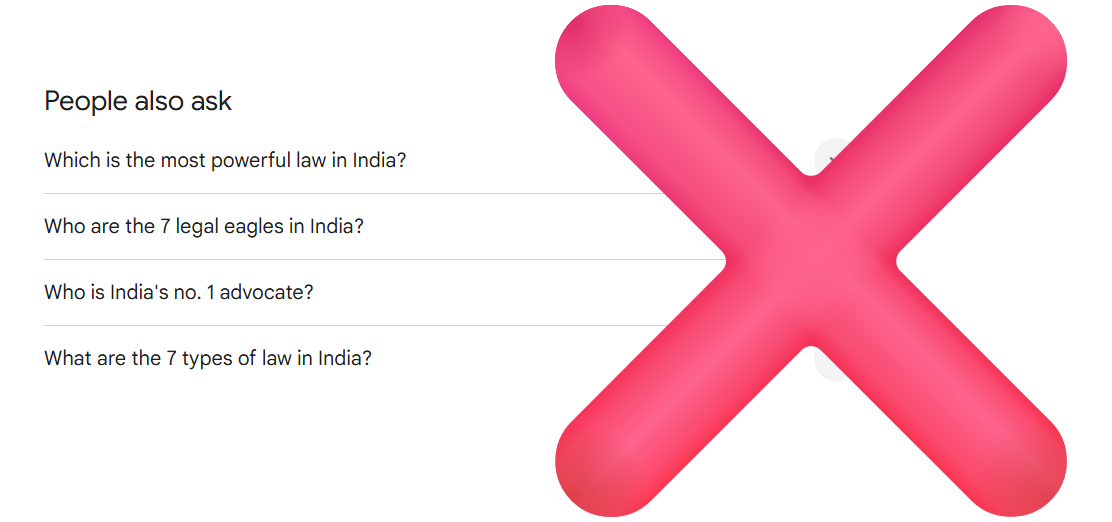
I remember when FAQ rich results first rolled out in May 2019. Every SEO consultant — including me — rushed to add FAQPage schema to everything. And why not? Those expandable accordions below a blue link gave you double the real estate in the SERP. Click-through rates improved. Clients were happy.
That era is officially over.
On May 7, 2026, Google completely removed FAQ rich results from Search. No more expandable Q&A blocks under your blue link. No more accordion format. Gone. And if you’re still running an SEO strategy built around chasing that visual treatment, this post is your wake-up call.
Here’s what actually changed, why it matters, and exactly what you should do next.
What Google Changed — And When It Actually Started
A lot of people are treating this like a sudden announcement. It isn’t. This has been a three-year rollback, and most commercial websites had already lost their FAQ rich results back in 2023.
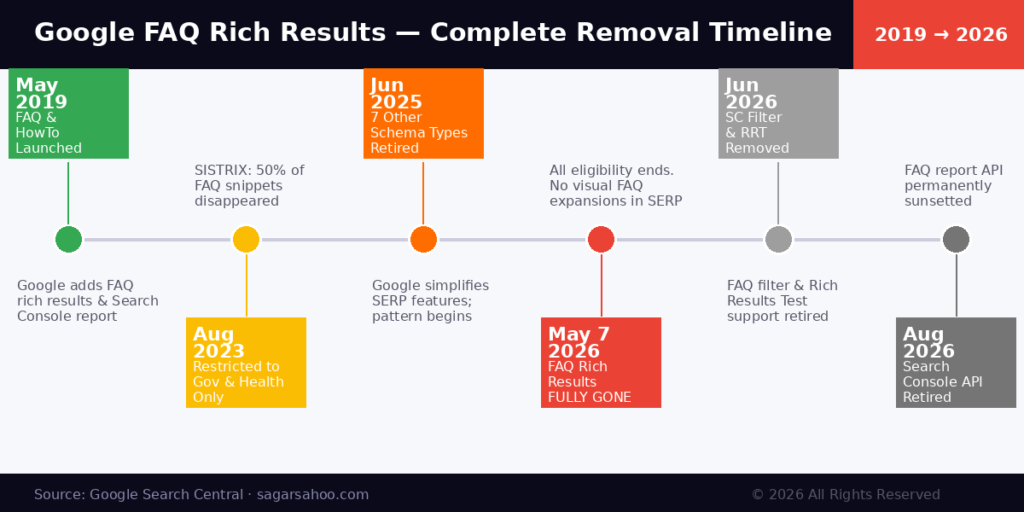
Here’s the full timeline:
- May 2019 — Google launches FAQ and How To rich results, along with a dedicated FAQ report in Google Search Console.
- August 2023 — Google restricts FAQ visibility to only well-known, authoritative government and health websites. SISTRIX reported that nearly 50% of FAQ snippets had already disappeared by mid-June 2023, with the rest following weeks later.
- June 2025 — Google retires seven other structured-data-driven SERP features as part of a broader simplification effort.
- May 7, 2026 — FAQ rich results stop appearing for all websites, including the government and health publishers that had been protected since 2023.
- June 2026 — Google will remove the FAQ filter in Search Console, the FAQ rich result report, and FAQ support in the Rich Results Test.
- August 2026 — FAQ rich result support is removed from the Search Console API entirely.
This phased retirement is deliberate. Google doesn’t pull features overnight. It signals first, then removes. And this time, the final signal came not with a dedicated blog post — but with a documentation update on May 8, 2026, added quietly to Google Search Central’s changelog.
That’s how low priority FAQ rich results had become for Google.
The Real SEO Impact: Traffic, CTR, and Reporting
Let me be direct: for most commercial websites, the actual traffic impact is smaller than the panic suggests.
John Mueller himself said back in 2023 that FAQ rich results had been used by only “a tiny set of site types.” By Google’s own 2023 restrictions, the vast majority of commercial publishers — e-commerce sites, SaaS companies, marketing blogs, local businesses — had already lost FAQ rich result eligibility years ago.
But that doesn’t mean you can ignore this update. Here’s where the real damage shows up:
CTR for Government and Health Publishers
If your site is in the health or government space and you were still earning FAQ expansions, you will feel a CTR drop. FAQ accordions gave visual prominence that plain blue links don’t. That expanded real estate helped click-through rates — and now it’s gone.
Google hasn’t published a May 2026 case study with hard CTR numbers from the final removal, so be skeptical of anyone claiming an exact percentage drop. What we can say confidently: expect fewer clicks from FAQ-driven impressions, especially on informational queries.
Reporting Chaos Is the Bigger Problem
This is where I want you to pay close attention. The operational impact of this update is mostly a reporting and governance issue, not a ranking issue.
Here’s what’s going away:
- The FAQ search appearance filter in Search Console → removed in June 2026
- FAQ rich result report → removed in June 2026
- FAQ support in Rich Results Test → removed in June 2026
- FAQ rich result support in the Search Console API → removed in August 2026
Action required: Export your historical FAQ appearance data from Search Console right now, before June. If you have Looker Studio dashboards or custom Search Console API pipelines that pull FAQ impression data, update those before August or they’ll break silently.
There’s also a compounding issue Google disclosed: a Search Console logging error affected impression reporting until April 27, 2026. If you’re doing a before/after comparison, that window is polluted. Any analysis using data before late April should be treated with extra caution.
What This Means for Schema Strategy in 2026
Here’s where the hot takes on LinkedIn have missed the nuance. I’ve seen two camps arguing this week:
- “FAQ schema is dead — remove it all.”
- “Schema is still valuable — stop panicking.”
Both are partly right. Neither tells you what to actually do.
Let me give you a cleaner framework.
What’s Dead: FAQPage as a SERP Real Estate Play
The use case for adding FAQPage markup solely to earn visual accordion expansions in Google is finished. That trade-off — structured markup → visible SERP treatment — no longer exists for FAQ content. Stop building schema strategy around decorating your blue links.
What’s Not Dead: Structured Data for Machine Clarity
Google’s own AI features guidance (updated for AI Overviews and AI Mode) is explicit: there is no special schema.org markup required to appear in AI Overviews or AI Mode. But it also says: structured data should match the visible text on the page.
This is the important part. FAQPage markup was never a shortcut into AI Overviews. It was — at best — one way of making already-visible answers cleaner for machines to read and extract. That purpose still has some value, but only if the underlying HTML content is strong first.
Gianluca Fiorelli put it well in his LinkedIn response to this update: people are confusing the death of a rich result with the death of schema as information architecture. Those are different things. Google pruning low-value visual treatments doesn’t mean it’s ignoring structured data — it means it’s getting more selective about what earns visual rewards.
FAQPage vs. QAPage — Don’t Confuse Them
One technical detail that matters: Google’s deprecation covers FAQPage specifically — pages where the site itself provides the questions and answers. It does not affect QAPage, which is intended for pages where multiple users contribute answers (think forums, community Q&A). QAPage is still documented and supported. Make sure you’re not accidentally removing valid QAPage markup during a cleanup sprint.
A Case Study Worth Learning From
In my experience auditing sites post-update, the publishers who handled the 2023 restriction best were the ones who never treated FAQ schema as a traffic strategy in isolation. They used it to support visible FAQ sections that already answered user intent well.
One health-adjacent client I work with had 14 pages with FAQPage markup. After the 2023 restrictions, they lost rich results on 11 of them. But their organic traffic barely moved. Why? Because the FAQ content itself was solid — users were finding those answers through featured snippets and AI Overviews, not through the accordion treatment.
The lesson: schema should support great content, not substitute for it. Pages that lost FAQ rich results but kept rankings were the ones where the visible HTML answered the question clearly — with or without the structured markup reward.
Your 5-Step Action Plan for Right Now
Based on what Google has confirmed and what I’ve seen in practice, here’s exactly what to do:
1. Export your FAQ appearance data from Search Console immediately.
Go to Performance → Search type → filter by “FAQ” appearance. Download everything before June 2026. Once the filter is gone, you lose historical visibility.
2. Audit your existing FAQPage markup.
Don’t mass-delete it in a panic. Evaluate each page: does this FAQ section genuinely help users? If yes, keep the content strong in visible HTML. The schema can stay — it costs you nothing to leave it, and Google has confirmed unused structured data doesn’t hurt your search performance
3. Stop adding new FAQPage markup purely for SERP decoration.
Any new structured data you add should earn its place through entity clarity and clean machine-readability — not the hope of an accordion. Ask yourself: does this help Google understand my content better? If yes, add it. If it’s just chasing a dead feature, skip it.
4. Separate FAQPage from QAPage in your templates.
If you’re running a site with user-generated Q&A content, make sure your developers aren’t accidentally blanket-removing QAPage markup in a cleanup. Those are different schema types with different use cases.
5. Update your reporting stack before August 2026.
If you have custom API integrations pulling FAQ data from Search Console, update them before the API support ends in August. Silent breakage in dashboards is worse than planned deprecation.
The Bigger Picture: What Google Is Actually Telling You
I’ve been watching Google’s structured data decisions for a long time. The pattern is clear: Google is removing visual rewards for schema that became a checkbox exercise rather than a genuine content signal. FAQ schema got overused. It was added to pages that had no real FAQ content. It was stuffed with keyword-rich questions that served the site, not the user. Google noticed — and slowly, deliberately, it removed the incentive.
The same fate could hit other schema types if they follow the same path.
The better SEO strategy — the one that survives future deprecations — is to focus on durable outcomes: entity clarity, accurate markup that matches visible page content, eligibility for features Google actively invests in (HowTo where still valid, Product, Review, Article schema), and most importantly, content that genuinely answers user intent.
Schema should be justified by what it does for the reader and the machine — not by the decoration it earns in a SERP you can no longer count on.
Final Takeaway
FAQ rich results are gone. That’s a fact. But your SEO strategy doesn’t have to collapse because of it.
The sites that will win in 2026 and beyond aren’t the ones chasing every new schema type for SERP decoration. They’re the ones building content that earns visibility through quality, depth, and genuine usefulness — with structured data that honestly describes what’s on the page.
That’s what I tell every client. And it’s more relevant today than ever.
Have questions about how this update affects your site specifically? Book a free SEO consultation and let’s audit your schema strategy together.