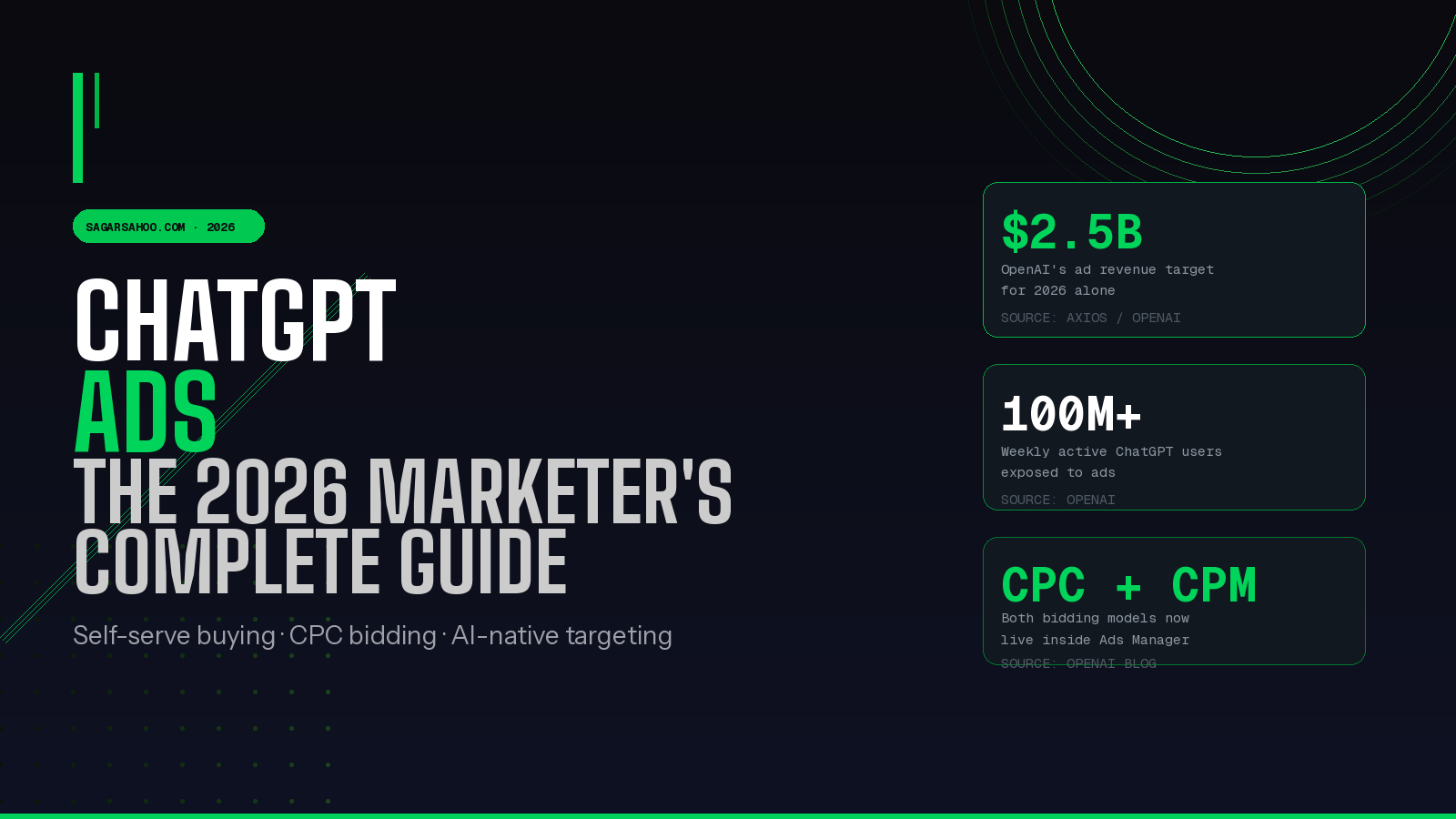
OpenAI just flipped the switch that digital marketers have been waiting for. On May 5, 2026, ChatGPT opened its advertising platform to self-serve buyers. No agency required. No $50,000 minimum spend. Any business — from a bootstrapped startup in Bengaluru to an enterprise brand in Mumbai. can now sign up, set a budget, upload creatives, and run ads inside one of the fastest-growing digital platforms on the planet.
I’ve been tracking the ChatGPT ads rollout since the first pilot in February 2026. And I’ll be honest with you: this is the most interesting new ad channel I’ve seen since Google launched Performance Max. The intent signals inside ChatGPT are unlike anything in traditional search or social. People aren’t scrolling mindlessly. They’re actively researching, comparing, and deciding.
If you’re a marketer or business owner who hasn’t looked at ChatGPT ads yet, this guide covers everything how it works, who it’s for, what the early data says, and exactly how to get started.
What Exactly Are ChatGPT Ads?
ChatGPT ads are sponsored placements that appear inside ChatGPT conversations shown to users when their query signals purchase intent or decision-making behaviour. Unlike traditional search ads where you target keywords, ChatGPT ads are placed contextually within conversations. OpenAI is clear about one thing: ads are clearly labelled and kept separate from ChatGPT’s organic answers. The goal is relevance, not interruption.
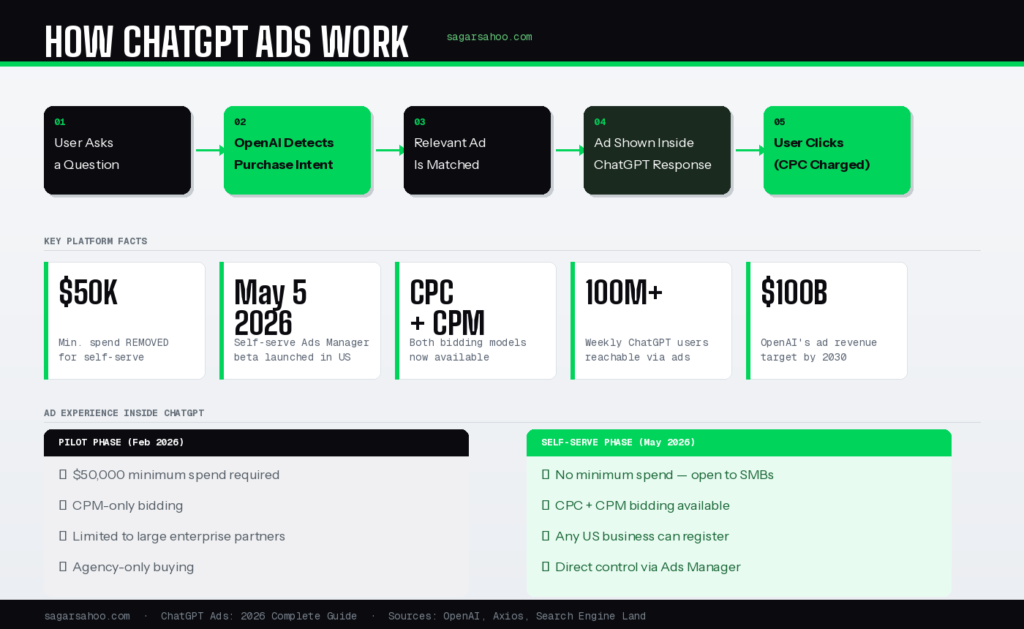
The formal pilot began on February 9, 2026, with a small group of large advertisers paying on a CPM (cost-per-mille) basis and working exclusively through holding company agencies like Dentsu, Omnicom, Publicis, and WPP.
The May 2026 expansion changed everything.
How the ChatGPT Ads Platform Works (May 2026 Update)
Self-Serve Ads Manager
The biggest shift is the launch of OpenAI’s beta Ads Manager, accessible at ads.openai.com. For the first time, any US-based business can:
- Register as an advertiser
- Add payment information
- Set budgets, bids, and pacing
- Upload ad creatives
- Launch and manage campaigns
- Monitor performance — all from one dashboard
This is the “phase two” of every major ad platform’s lifecycle. Google did it. Meta did it. Now OpenAI is doing the same: move from high-touch, agency-led campaigns to scalable self-serve tools.
CPC Bidding — Why It’s a Big Deal
During the pilot phase, ChatGPT ads were sold purely on a CPM (cost-per-impression) basis. That meant advertisers paid for eyeballs, not actions. OpenAI has now added cost-per-click (CPC) bidding, and the reasoning is sharp:
ChatGPT conversations are active and decision-oriented. Someone asking “what’s the best CRM for a 10-person sales team?” is not passively scrolling Instagram. They’re moments away from a buying decision. CPC bidding lets advertisers align spend directly with those high-intent actions.
Both CPM and CPC buying remain available, and OpenAI has signalled more bidding options are coming.
Agency & Tech Partners
For brands that prefer managed buying, OpenAI has partnered with major holding companies and ad tech platforms:
Agency partners: Dentsu, Omnicom, Publicis, WPP
Tech partners: Adobe, Criteo, Kargo, Pacvue, StackAdapt
Through these partners, advertisers can access ChatGPT inventory using the planning and buying systems they already use — while OpenAI retains full control over all ad delivery decisions inside ChatGPT.
Measurement & Conversion Tracking
OpenAI has introduced pixel-based tracking and a Conversions API, meaning advertisers can now see what happens after a user engages with an ad. This closes the attribution gap that was making early-stage advertisers nervous. Without conversion data, it’s nearly impossible to justify budget — so this is a foundational update.
The Numbers You Need to See
Before you decide whether to test this channel, here are the facts:
- OpenAI’s stated ad revenue target is $2.5 billion for 2026 and $100 billion by 2030 (Source: Axios)
- ChatGPT has over 100 million weekly active users globally — all now potentially reachable via ads
- The previous $50,000 minimum spend has been removed for self-serve advertisers
- The platform launched formally on February 9, 2026, with the self-serve expansion on May 5, 2026
- Early-phase CPCs are reportedly lower than established platforms because auction competition is still thin
That last point matters. I always tell clients: the best time to test a new ad channel is before everyone else does. CPMs and CPCs are soft right now. That window won’t last.
Case Study: What Early Advertisers Reported
Note: Public case study data from OpenAI’s pilot is limited due to NDA restrictions — the following reflects aggregated industry reporting from Search Engine Land, Axios, and MaaS Blog as of May 2026.
During the closed pilot phase (February–April 2026), early advertisers — primarily large US brands — reported several interesting patterns:
The intent signal quality was unusually high. Unlike social ads where users are often in passive consumption mode, ChatGPT users engage actively with product-related queries. When someone asks “compare Shopify and WooCommerce for a D2C brand,” the purchase intent embedded in that question is explicit. Early pilot advertisers noted that engagement quality, not just volume, was a standout metric.
Conversion paths were longer but higher-value. Users didn’t click and buy immediately. They tended to continue the conversation, gathering more context — but when they did convert, average order values trended higher than equivalent Google or Meta campaigns.
Ad format matters. Ads that fit naturally into the conversational flow performed better than those that felt disruptive. This is a signal for creative strategy: write ad copy that sounds like a helpful recommendation, not a banner headline.
One D2C brand in the SaaS category reportedly cut their cost-per-qualified-lead by 22% during the first three weeks of the pilot, compared to their Google Search baseline — though this data is anecdotal and pilot-phase results are inherently variable.
Who Should Test ChatGPT Ads Right Now?
Not every business should rush in. Here’s how I’d evaluate it:
Strong candidates:
- SaaS and B2B products where users research before buying
- E-commerce brands in high-consideration categories (electronics, appliances, fintech)
- Service businesses where lead quality matters more than lead volume
- D2C brands with strong creative assets and clear differentiation
- Agencies who want to offer clients a first-mover edge
Wait and watch:
- Businesses with very local or hyper-niche audiences (ChatGPT targeting is still broad)
- Brands with no creative bandwidth — thin copy will hurt you here
- Performance-only advertisers with tight ROAS requirements and no patience for a test-and-learn phase
If you’re already spending on Google Search and getting solid results, you have the baseline to compare against. That’s the right mindset for testing ChatGPT ads — it’s an experiment, not a replacement.
How to Get Started with ChatGPT Ads (Step-by-Step)
Step 1: Register at ads.openai.com
The self-serve Ads Manager is currently in beta and being opened gradually. Apply early — access isn’t instant. Visit ads.openai.com and sign up with your business details.
Step 2: Define Your Objective
Are you optimising for clicks, conversions, or brand awareness? This determines whether you start with CPC or CPM bidding. For most performance-driven marketers, start with CPC and let OpenAI’s system optimise toward action.
Step 3: Prepare Your Creative
ChatGPT ad creatives need to feel conversational and relevant — not like repurposed display banners. Write copy that answers a question, provides a genuine comparison, or adds value. Think “helpful recommendation” rather than “hard sell.”
Step 4: Set Your Budget and Pacing
There is no minimum spend for self-serve advertisers. I’d recommend starting with a defined test budget — ₹50,000 to ₹1,50,000 INR equivalent for a 30-day pilot if you’re targeting globally — and scaling only after you’ve validated your conversion events.
Step 5: Install the Pixel and Connect the Conversions API
This is non-negotiable. Without conversion tracking, you’re flying blind. OpenAI now offers both a pixel and a Conversions API (similar to Meta’s CAPI setup). Get this live before your first campaign.
Step 6: Monitor and Optimise Weekly
Early campaigns need frequent check-ins. Watch your CTR by creative variant, monitor conversion rates from the landing page side, and adjust pacing if delivery is too slow or too fast.
Why Indian Marketers Should Pay Attention Now
The self-serve Ads Manager is currently US-only in beta. India-based advertisers cannot yet buy directly through the self-serve portal.
But here’s what I’d tell every Indian marketer: prepare now.
OpenAI’s global expansion playbook is predictable. The US self-serve launch is phase two. Phase three will include broader international markets — and India, with its rapidly growing digital ad spend and large ChatGPT user base, is an obvious priority.
What you can do today:
- Build brand visibility inside ChatGPT through structured content (GEO — Generative Engine Optimisation)
- Explore access via global agency partners like StackAdapt or Criteo if you have international campaigns
- Study what US advertisers are learning right now and build your playbook in advance
The brands that win on ChatGPT ads in India won’t be the first to get access. They’ll be the ones who showed up prepared.
FAQ: ChatGPT Ads Explained
What are ChatGPT ads?
ChatGPT ads are sponsored placements shown inside ChatGPT conversations when users display purchase intent or are actively researching products and services. They are clearly labelled and kept separate from ChatGPT’s organic answers.
How much does it cost to advertise on ChatGPT?
As of May 2026, there is no minimum spend for self-serve advertisers using the beta Ads Manager. During the early pilot, the minimum was $50,000. Advertisers can now buy on either a CPC (cost-per-click) or CPM (cost-per-mille) basis.
Are ChatGPT ads available in India?
Currently, the self-serve Ads Manager is available to US-based advertisers in beta. International access, including India, has not been officially announced yet. Advertisers can explore access through global agency and tech partners such as Dentsu, Omnicom, Criteo, and StackAdapt.
How are ChatGPT ads different from Google Ads?
Google Ads target specific search keywords. ChatGPT ads are placed contextually within conversations, triggered by intent signals in the full conversational context — not just a keyword match. This makes the intent signal potentially deeper but also less precise.
Can small businesses run ChatGPT ads?
Yes — the May 2026 launch of the self-serve Ads Manager specifically removed the large minimum spend requirement to open access to SMBs and startups. OpenAI stated the platform is designed “for companies of all sizes, from SMBs and startups to global brands.”
Conclusion
ChatGPT ads are no longer a pilot reserved for companies with $50,000 to burn on an experiment. They’re a structured, self-serve advertising platform with CPC bidding, conversion tracking, and open access for US businesses — with global expansion on the horizon.
The intent quality inside ChatGPT is unlike any other channel. People using it aren’t browsing — they’re deciding. That’s the most valuable advertising moment there is.
My recommendation: if you’re a performance marketer or growth-focused business owner, get into the beta now, set up conversion tracking first, and treat the first 30 days as a learning investment. The CPCs are still soft. The competition is still thin. That won’t last.
Want help building your ChatGPT ads strategy before your competitors get there? Book a free SEO and digital growth consultation at sagarsahoo.com