If you checked your Google Search Console on the morning of May 21, 2026, and noticed your rankings moving. you are not imagining it. The Google May 2026 core update is officially rolling out, and it is the second major algorithm change this year.
I have seen three clients already asking me the same question: “Did something break on my site?” The short answer is probably not. But something definitely changed in how Google is evaluating your content.
In this post, I am breaking down exactly what the SEO core May update means, who it affects, what the data says so far, and the step-by-step actions you should take right now. No panic. No guesswork. Just what actually works.
What Is the Google May 2026 Core Update?
On May 21, 2026, Google announced via its Search Status Dashboard that it had released a new core update. The rollout can take up to two weeks, which means results will continue shifting until approximately June 4, 2026.
Google’s official statement: “This is a regular update designed to better surface relevant, satisfying content for searchers from all types of sites.”
This is the second core update of 2026. The first was the March 2026 core update, which ran from March 27 to April 8 and caused significant volatility across industries. The May update follows a clear pattern: Google is accelerating its shift toward rewarding genuinely helpful, experience-driven content and penalizing pages that exist primarily to chase keywords.
What is different this time? Google is now using advanced Gemini-based quality models in its ranking systems. This means the algorithm is better at detecting whether your content genuinely helps the reader or simply looks like it does.
Core Update Timeline: 2026 So Far
Context matters when reading core update signals. Here is the full picture of what Google has rolled out this year:
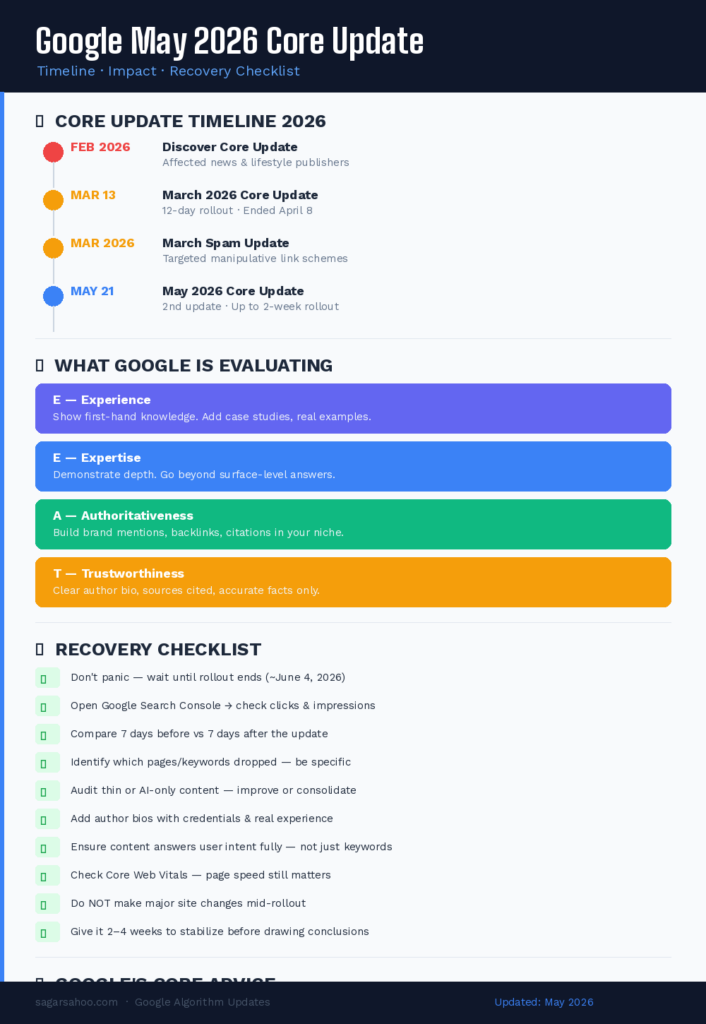
- February 2026 Discover Update — affected news and lifestyle publishers in the Google Discover feed
- March 13, 2026 Core Update — 12-day rollout, ended April 8, caused wide ranking shifts across industries
- March 2026 Spam Update — targeted manipulative link schemes and low-quality bulk content
- May 21, 2026 Core Update — rolling out now, up to 2 weeks, Gemini-powered quality evaluation
Each update has tightened the same signal: Google is increasingly rewarding sites with real depth, credible authorship, and content that delivers on its promise to the user. The May 2026 update is not an isolated event. It is the next step in a long-term directional shift.
Who Gets Hit by the SEO Core May Update?
On May 21, 2026, Google announced via its Search Status Dashboard that it had released a new core update. The rollout can take up to two weeks, which means results will continue shifting until approximately June 4, 2026.
Google’s official statement: “This is a regular update designed to better surface relevant, satisfying content for searchers from all types of sites.”
This is the second core update of 2026. The first was the March 2026 core update, which ran from March 27 to April 8 and caused significant volatility across industries. The May update follows a clear pattern: Google is accelerating its shift toward rewarding genuinely helpful, experience-driven content and penalizing pages that exist primarily to chase keywords.
What is different this time? Google is now using advanced Gemini-based quality models in its ranking systems. This means the algorithm is better at detecting whether your content genuinely helps the reader or simply looks like it does.
Core Update Timeline: 2026 So Far
Context matters when reading core update signals. Here is the full picture of what Google has rolled out this year:
- February 2026 Discover Update — affected news and lifestyle publishers in the Google Discover feed
- March 13, 2026 Core Update — 12-day rollout, ended April 8, caused wide ranking shifts across industries
- March 2026 Spam Update — targeted manipulative link schemes and low-quality bulk content
- May 21, 2026 Core Update — rolling out now, up to 2 weeks, Gemini-powered quality evaluation
Each update has tightened the same signal: Google is increasingly rewarding sites with real depth, credible authorship, and content that delivers on its promise to the user. The May 2026 update is not an isolated event. It is the next step in a long-term directional shift.
Core updates do not target individual pages or specific policy violations. They recalibrate the entire scoring system across billions of pages at once. That said, some patterns tend to lose ground consistently.
Sites That Typically Drop
- Pages with thin or padded content — articles that repeat the same point five different ways without adding insight
- AI-generated content without human editing, real examples, or expert review
- Pages that answer a query but do not satisfy it — technically correct but not genuinely useful
- Sites with weak E-E-A-T signals — no clear author, no credentials, no trust indicators
- Ad-heavy pages where the content is buried under monetization
Sites That Typically Gain Ground
- Pages with deep, original content that reflects real experience or research
- Authoritative niche sites with consistent topic coverage and strong internal linking
- Content with clear authorship, credentials, and cited sources
- Pages that match search intent precisely not just the keyword but the underlying question
Case study insight: An SEO agency tracking 40+ client sites during the March 2026 update found that pages with author bios, cited statistics, and structured FAQs held their positions 3x more consistently than pages without these trust signals. The May update reinforces the same pattern.
E-E-A-T: The Real Framework Behind Core Updates
Every major core update since 2022 has been moving in the same direction: rewarding content that demonstrates Experience, Expertise, Authoritativeness, and Trustworthiness. If you want to understand what the May 2026 core update is actually measuring, this framework is the lens.
Experience
Google wants to see that the person writing the content has actually done the thing they are writing about. First-hand knowledge beats research-only content. If you run an SEO blog, write about campaigns you have personally worked on. Include real data, real mistakes, and real wins.
Expertise
Depth matters more than length. A 600-word post that gives a precise, complete answer outperforms a 2,000-word post that dances around the topic. Expertise is demonstrated through specificity, not word count.
Authoritativeness
This is about your brand and domain reputation in the niche. Backlinks from credible industry sources, mentions in authoritative publications, and a consistent publishing track record all build this signal over time. You cannot fake authority — you build it.
Trustworthiness
Clear author bios, HTTPS, accurate sourcing, and transparent business information. Trust signals are often the easiest wins during core update recovery because they are purely structural and can be added quickly.
How to Check If You Were Hit: Google Search Console Guide
Before you do anything, open Google Search Console. Here is the exact process I use for every client when a core update rolls out:
1. Go to Performance > Search Results and set the date range to the last 28 days.
2. Compare the 7 days before May 21 against the 7 days after using the Compare feature.
3. Filter by Pages to identify which URLs lost the most clicks and impressions.
4. Note whether the drop is site-wide or concentrated in specific sections or topics.
5. Check your competitors in the same niche to see if they moved up or also dropped.
Important: Do not draw hard conclusions until the rollout is complete around June 4. Rankings are actively shifting mid-update, and acting on incomplete data often leads to changes that fix temporary fluctuations, not the real issue.
What to Do After the Rollout Ends: Recovery Checklist
Google is consistent in one thing: there are no quick fixes after a core update. Recovery is not about tricks — it is about genuinely improving the quality and depth of your content.
Here is where to start:
Audit Your Thin Pages First
Use a crawl tool like Screaming Frog to identify pages under 500 words or pages with high impressions but low click-through rates. These are your lowest-hanging fruit. Either improve them substantially or consolidate them into a stronger, more comprehensive page.
Add Real Author Signals
Every post should have a named author with a short bio that mentions their actual credentials and experience. This is not optional for sites in health, finance, legal, or any YMYL category. Google quality raters look for this explicitly.
Rethink Content That Dropped
If a specific page dropped significantly, the first question to ask is not “what technical issue caused this” but “does this page actually satisfy the search intent better than the pages now outranking it?” Open those competing pages. Read them. Ask yourself what they do better and whether your page can genuinely surpass them.
Check Your Technical Foundation
Before blaming the update entirely, verify your Core Web Vitals, XML sitemap health, and crawlability. A slow-loading page with broken internal links is fighting the algorithm with one hand tied behind its back. Google Search Console Core Web Vitals report and Screaming Frog give you this picture quickly.
The Bigger Picture: What Google Is Really Building Toward
I have been tracking Google core updates closely since 2020, and the directional trend is unmistakable. Google is moving toward a version of search where the algorithm understands not just what a page says, but whether it reflects genuine human knowledge and real utility.
The May 2026 update is particularly significant because it coincides with Google deploying Gemini 3.5 Flash to AI Mode globally and AI Mode reaching one billion monthly users. The lines between traditional search and AI-generated answers are blurring. Sites that win in this environment will be the ones that produce content a human expert would actually write — specific, opinionated, sourced, and useful.
My takeaway: Stop writing for rankings. Start writing to become the most useful resource on your topic. The algorithm is getting good enough to tell the difference.
Final Takeaways
The Google SEO core May 2026 update is not a reason to panic but it is a clear signal. If your rankings moved, treat it as useful information, not a crisis. Wait for the rollout to complete, pull your Search Console data, and focus on genuine quality improvements.
The sites gaining ground consistently through every 2026 update share one thing: they build topical authority and content depth between updates, not just after them. That is the only strategy that compounds.
Frequently Asked Questions
How long will the Google May 2026 core update take?
Google confirmed the rollout may take up to two weeks from May 21, putting the expected completion around June 4, 2026. Past core updates have sometimes completed faster, but you should not draw final conclusions until the rollout is officially marked complete.
My rankings dropped after the May 2026 update. What should I do?
First, wait until the rollout finishes before making major changes. Then use Google Search Console to identify which pages dropped and by how much. Compare those pages against the ones currently ranking above you and identify genuine quality gaps. Focus on content depth, E-E-A-T signals, and search intent alignment.
Can I recover before the next core update?
Partial recovery between updates is possible. Google runs smaller unannounced core updates continuously, which means quality improvements can be recognized before the next major update. However, the biggest ranking recoveries typically happen after a subsequent major core update.
Does the May 2026 update affect AI-generated content?
Google does not penalize AI-generated content automatically. What it penalizes is low-quality content regardless of how it was produced. If your AI-generated pages lack depth, first-hand experience, proper editing, and E-E-A-T signals, they are vulnerable. Human editing and genuine expertise layered on top of AI drafts is the standard.
Is the May 2026 update related to the March 2026 core update?
They are part of the same directional push. The March 2026 update caused significant volatility and established a new baseline. The May 2026 update is continuing that recalibration, now with Gemini-based quality models playing a larger role in content evaluation.