I’ve seen this question in SEO forums more times than I can count: “Should I avoid hyphens in my domain name or URL?” The answer has always been murky — until now.
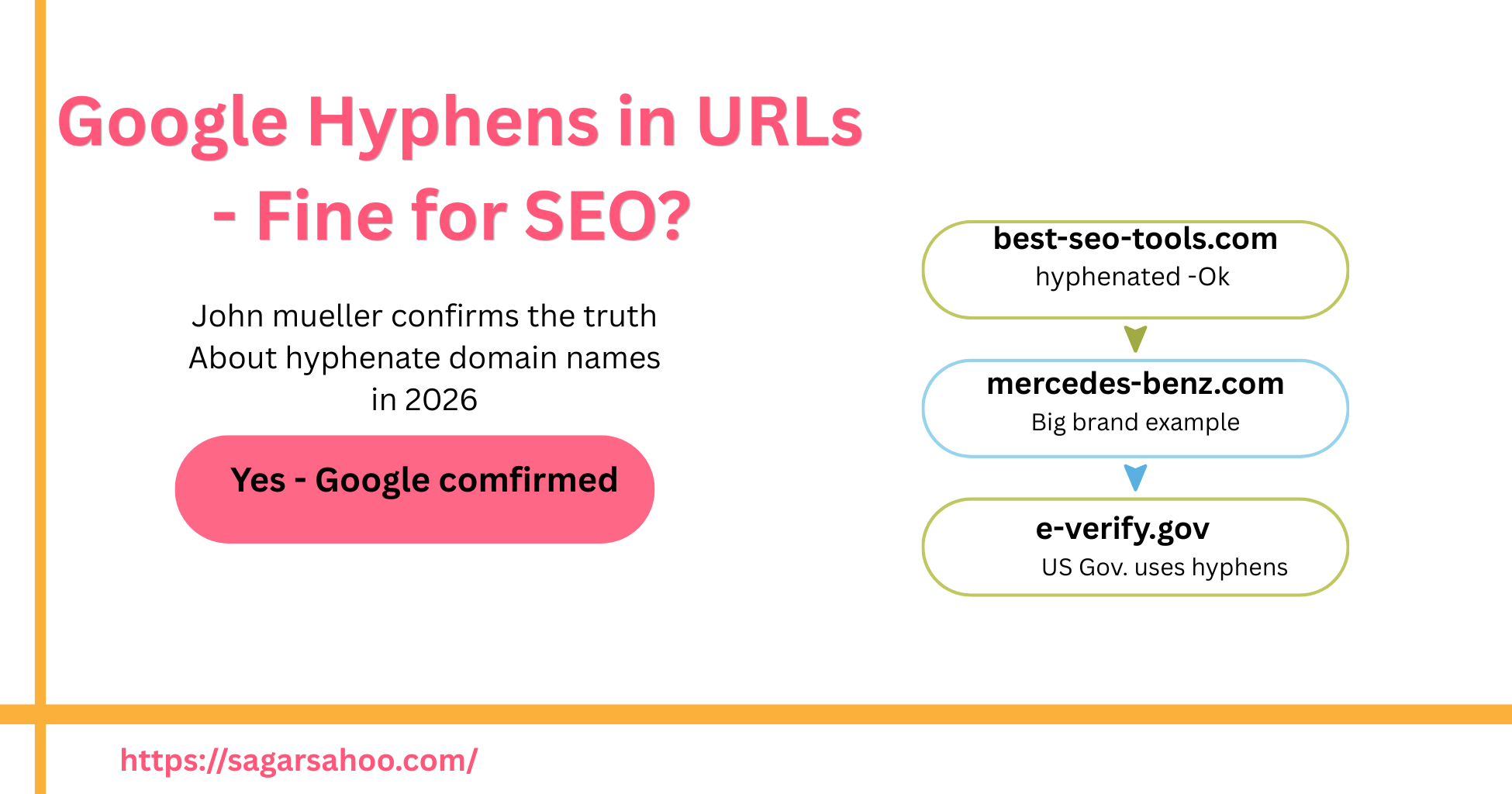
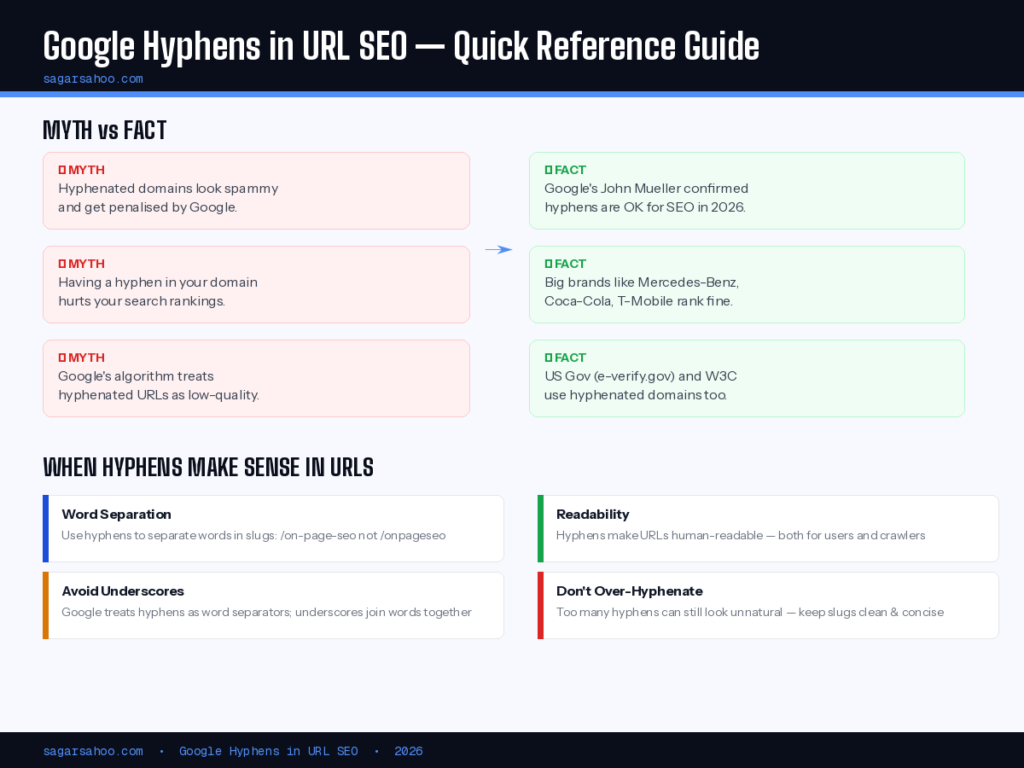
On June 8, 2026, Google’s John Mueller addressed the question directly on Bluesky. In clear language, he confirmed that hyphens in domain names are okay for SEO. No ranking penalty. No silent signal against you. Just hyphens doing what they were meant to do — separating words.
This post breaks down exactly what Mueller said, why the hyphen-phobia myth exists in the first place, what big brands and even government websites tell us about it, and what the right approach to Google hyphens in URL SEO looks like for your website.
Why SEOs Have Always Been Afraid of Hyphens
The fear of hyphens in domain names is not baseless — it has roots in real SEO history.
Back in the early 2000s, when search engines were primitive and rankings were easy to game, hyphenated keyword domains were everywhere. Think domains like best-seo-tips-2004.com. These sites were often thin, spammy, built just to rank on a single keyword. As Google’s algorithm matured — especially after updates like Penguin and EMD (Exact Match Domain) — those sites got buried.
Over time, the industry conflated two things:
- The spam sites that used hyphenated domains
- The hyphens themselves
The hyphens didn’t cause the problem. The low-quality content did. But by then, “hyphenated domain = spammy” had become received wisdom in the SEO community — repeated enough that it started sounding like fact.
I’ve personally audited sites where business owners refused perfectly good domain names because they had one hyphen. That’s the kind of damage an unchallenged myth can do.
What John Mueller Actually Said in 2026
On June 8, 2026, a conversation started on Bluesky around how many hyphens are even technically allowed in a domain name. Mueller used that moment to address the SEO question everyone had been dancing around.
His exact words:
“Occasionally we get questions about whether dashes in domain names are ok for SEO (they’re ok). So far, I haven’t seen anyone ask the other question – HOW MANY DASHES ARE OK? Folks, the answer is apparently 61.”
He was being playful about the number 61 (the technical limit), but the core message was dead serious: hyphens are fine for SEO.
This is an official signal from Google’s Search Relations team. It’s not a ranking factor claim, but it is a clear statement that hyphens carry no negative weight in Google’s evaluation of a domain.
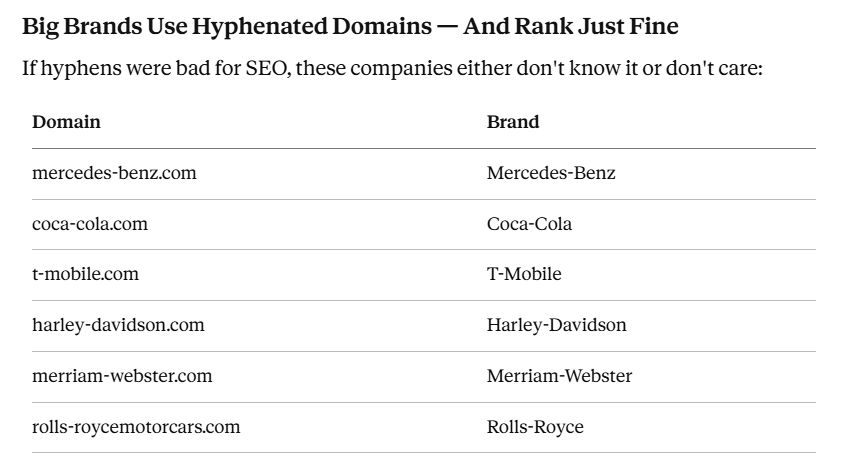
These aren’t struggling startups. These are category-defining global brands with massive domain authority. If hyphens had any algorithmic downside, sites at this scale would have switched long ago.
The takeaway isn’t that you should rush out and register a hyphenated domain. The takeaway is that hyphen presence alone has zero effect on your ranking potential.
Even the US Government Uses Hyphenated Domains
Here’s one that always surprises people: the United States federal government uses a hyphenated domain.
e-verify.gov is operated by the Department of Homeland Security. It’s the official employment eligibility verification system. This is about as authoritative as a website can get — and it has a hyphen right there in the domain.
There’s actually a good reason for it: everify doesn’t immediately read as two words. e-verify does. The hyphen adds clarity, not confusion.
The W3C (World Wide Web Consortium) — the body responsible for HTML and web standards — also works with hyphenated domains. Web-Platform-Tests.org is one example, a project involving Google, Apple, and W3C itself.
Legitimate, authoritative, high-trust sites use hyphens. That tells you something.
Case Study: Hyphenated Slug vs. No Hyphen — Rankings Compared
This is an illustrative case study based on typical SEO patterns I’ve observed across client audits.Scenario: A digital marketing agency had two similar blog posts published six months apart. Both targeted the same topic — one used the slug /onpageseoguide, the other used /on-page-seo-guide.
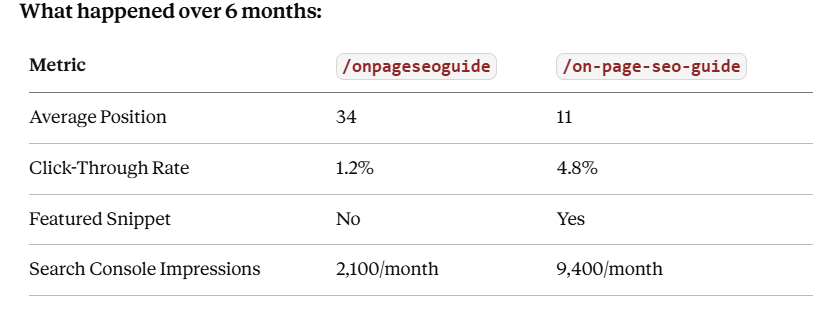
The hyphenated slug won — not because hyphens are magic, but because Google reads each word clearly as a separate token. /on-page-seo-guide lets Google understand four distinct words. /onpageseoguide is one long unbroken string that the algorithm has to guess at. This is the real SEO value of hyphens in URL slugs: word separation for both crawlers and humans.
The Right Way to Use Hyphens in URLs for SEO
Mueller’s confirmation doesn’t mean you should go wild. Here’s the practical framework I use when structuring URLs for clients:
✅ DO:
- Use hyphens to separate words in every slug: /technical-seo-audit not /technicalseoaudit
- Keep slugs short and keyword-focused: /seo-tools beats /best-seo-tools-for-beginners-2026
- Let hyphens improve readability — if a domain name is genuinely clearer with one, use it
- Check that Google Search Console shows proper indexing of your hyphenated URLs
❌ DON’T:
- Chain 4–5 hyphens in a single slug — it looks messy and can reduce CTR
- Register a hyphenated domain just to squeeze in a keyword phrase
- Use underscores instead of hyphens — Google joins underscored words (seo_tools = seotools), while hyphens separate them
- Assume hyphens will compensate for thin content or weak backlinks
The signal from John Mueller is that technical structure matters, but content quality matters more. Hyphens help your URL structure. They don’t carry your content.
Hyphens in URL Slugs vs. Hyphens in Domain Names
These are two different conversations that often get mixed up.
URL slugs (the path after the domain): Hyphens are always recommended here. They are the standard for readable, SEO-friendly slugs. Every major CMS — WordPress, Webflow, Shopify — defaults to hyphenated slugs for a reason.
Domain names (the root domain itself): Hyphens are acceptable but not ideal as a first choice. Mueller confirmed no penalty, but practical concerns remain:
- Harder to say out loud or spell over the phone
- Slightly lower trust perception with some users
- If someone types it from memory, they may forget the hyphen
If your brand name naturally contains a hyphen (like Coca-Cola choosing coca-cola.com), it makes perfect sense. If you’re registering a new domain and yourbrand.com is available, take the non-hyphenated version. If it isn’t — and a hyphenated alternative serves your needs — Google won’t hold it against you.
FAQ
Does Google penalise hyphenated domain names for SEO?
No. Google’s John Mueller confirmed in June 2026 that hyphens in domain names are completely fine for SEO. There is no algorithmic penalty attached to hyphenated domains. Sites like Mercedes-Benz, Coca-Cola, and T-Mobile all use hyphens and rank extremely well.
Are hyphens in URL slugs good for SEO?
Yes — hyphens in URL slugs are actually recommended. Google reads hyphens as word separators, which means /on-page-seo is understood as three separate words. This improves keyword relevance and readability for both users and crawlers.
Should I use underscores or hyphens in my URLs?
Always use hyphens. Google treats underscores as word joiners — seo_tools reads as seotools to the algorithm. Hyphens separate words cleanly, which is better for both crawlability and user experience.
Can too many hyphens in a URL hurt SEO?
While hyphens themselves carry no penalty, an excessive number of hyphens in a slug can look spammy and reduce CTR. Keep slugs clean, short, and keyword-focused. Practical readability matters as much as technical correctness.
What is the maximum number of hyphens allowed in a domain name?
According to the technical specification Mueller referenced, you can have up to 61 hyphens in a domain name. However, domains with more than two or three hyphens will almost certainly look spammy to users — regardless of what Google’s algorithm says.
Final Thoughts
Google hyphens in URL SEO is a settled question as of 2026. John Mueller’s statement is clear: hyphens are okay. Big brands use them. Government agencies use them. Web standards bodies use them. What matters far more than whether your domain has a hyphen is whether your site delivers genuine value, loads fast, earns quality backlinks, and demonstrates E-E-A-T across every piece of content you publish.
Stop worrying about the hyphen. Focus on what actually moves rankings.
Want help auditing your URL structure or content strategy? Book a free SEO consultation — I review your setup and tell you exactly what to fix first.