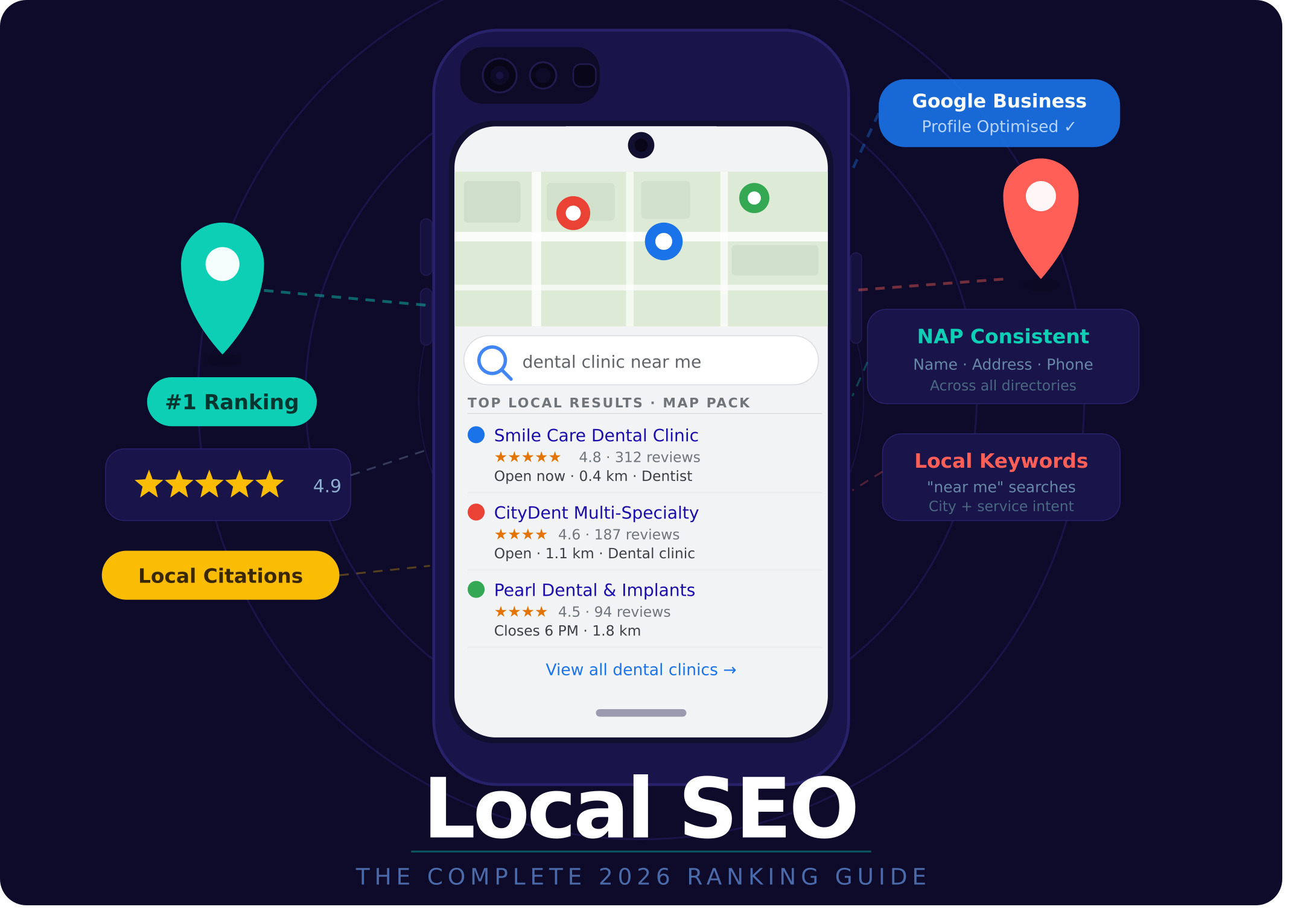
If you run a local business a salon, a dental clinic, a restaurant, a plumbing service — there is one question that should keep you up at night:
When someone nearby searches for what I offer, do they find me or my competitor?
That is the heart of local SEO.
Local SEO is not just another digital marketing buzzword. It is a practical, proven set of strategies that helps your business show up in Google’s search results when people in your area are actively looking for what you sell. And unlike paid ads that stop the moment your budget dries up, a well-built local SEO presence keeps working for you around the clock.
Think about your own behaviour as a consumer. When you need a dentist, a mechanic, or a good cup of coffee, you pull out your phone and search. You barely scroll past the first three results. If a business does not appear there, it does not exist for you in that moment.
This guide covers everything you need to know to rank higher in local search in 2026 — from setting up and optimising your Google Business Profile, to finding the right local keywords, building consistent citations, earning reviews, and creating location pages that actually convert.
Let us get into it.
What Is Local SEO?
Local SEO is the process of optimising your online presence so your business appears prominently in search results when people nearby search for your products or services.
When someone types “barber near me” or “emergency plumber in Mumbai,” Google recognises the local intent behind that query and shifts into a different mode. Instead of showing blog posts or Wikipedia articles, it surfaces businesses, maps, and listings that are geographically relevant to the searcher.
A strong local SEO strategy helps you:
- Attract high-intent customers who are ready to buy, call, or visit
- Drive consistent foot traffic and phone enquiries
- Build brand visibility in your local community
- Compete with larger brands that dominate national search results
The key difference between local SEO and traditional SEO is scope. Standard SEO targets a broad, geographically diverse audience. Local SEO zeroes in on a specific area — your city, your neighbourhood, or your service radius.
How Google Decides Who Ranks Locally
Before diving into tactics, it helps to understand how Google actually ranks local businesses.
When Google detects local intent in a search query, it evaluates three core factors:
1. Relevance
How closely does your business match what the person is searching for? This is why your Google Business Profile category, services listed, and business description matter so much. The more accurately you describe what you do, the more relevant Google considers you for the right searches.
2. Distance
How far is your business from the searcher’s location (or the location they mentioned in the query)? Google uses GPS data, IP addresses, and location history to estimate where someone is searching from. Businesses closer to the searcher naturally have an advantage — but relevance and prominence can outweigh distance in competitive queries.
3. Prominence
How well-known and reputable is your business, both online and offline? Prominence is influenced by the number and quality of your reviews, the authority of websites linking to you, your NAP citation consistency, and how often your brand is mentioned across the web.
These three factors together determine whether you appear in the most coveted piece of real estate in local search: the Map Pack.
The Google Map Pack: What It Is and Why It Matters
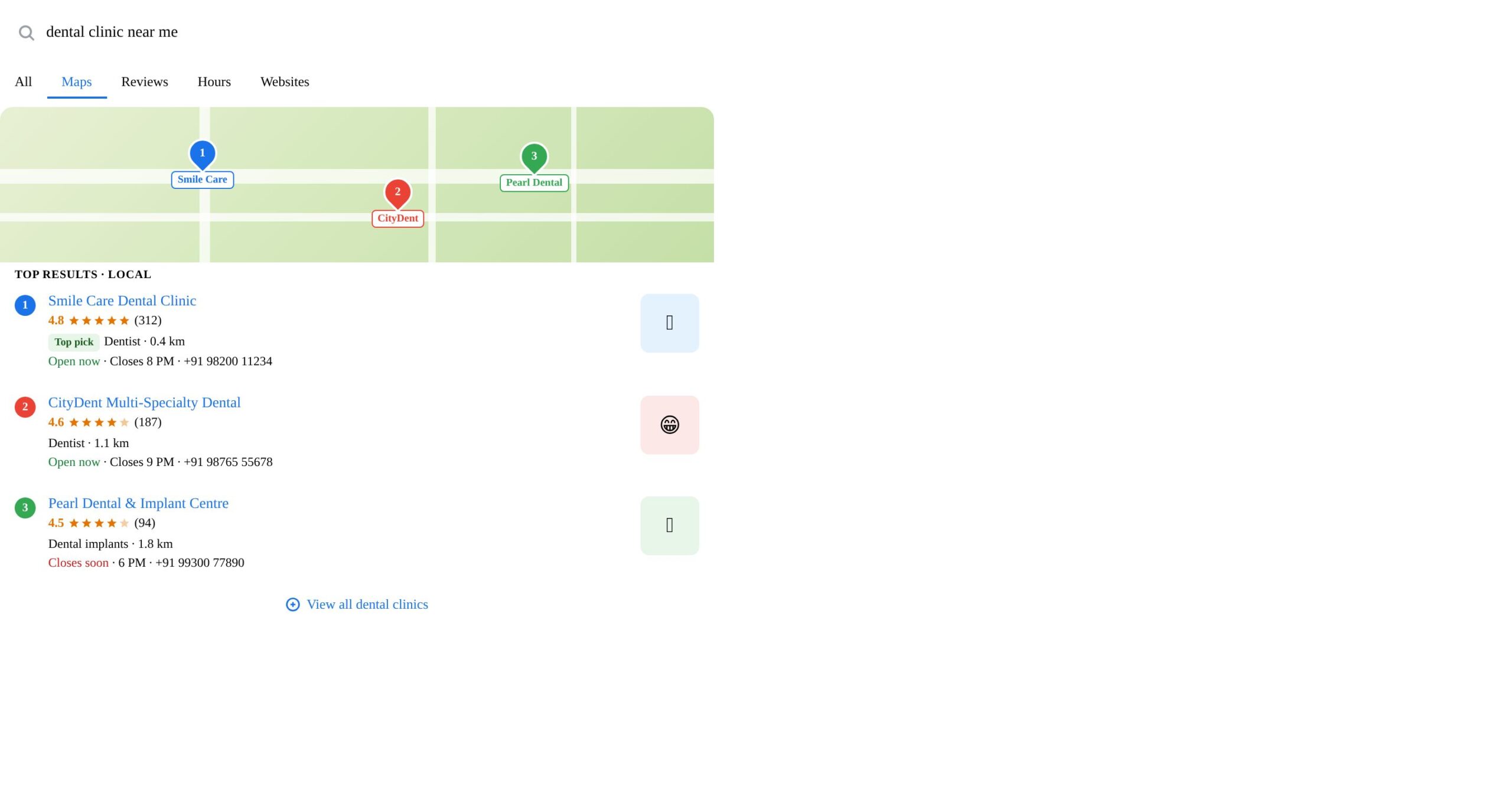
The Map Pack — also called the local pack or 3-pack — is the cluster of three business listings that appears at the top of Google’s search results for local queries, accompanied by a map.
If you have ever searched for “restaurants near me” and seen a map with three highlighted options before any blue links, that is the Map Pack.
Ranking in the Map Pack is enormously valuable:
- It sits above organic results, commanding immediate attention
- It gets a disproportionate share of clicks, especially on mobile devices
- It displays your rating, hours, phone number, and location at a glance — making it easy for customers to act immediately
The primary source that feeds Map Pack rankings is your Google Business Profile (GBP). Without a well-optimised GBP, you are essentially invisible in the Map Pack, regardless of how good your website is.
Below the Map Pack, you will also find local organic results — the traditional blue-link listings. These capture people who want to research before deciding. Ranking in both the Map Pack and local organic results gives you maximum local search visibility and significantly increases your chances of winning the click.
Step 1: Find Local Keywords That Bring You Customers
Every strong local SEO strategy starts with keyword research. You need to understand exactly what terms your potential customers type into Google when they are looking for a business like yours.
Start with Google Itself
You do not need expensive tools to start. Open Google and search for your service plus your city — something like “physiotherapist in Pune” or “wedding photographer Delhi.” Then pay close attention to what appears:
The Map Pack listings — Read the GBP descriptions carefully. They often contain important keyword phrases like “same-day appointments” or “affordable family dentist” that signal what people are searching for.
“People also ask” boxes — These questions reveal exactly what your potential customers want answered. They are also excellent long-tail keyword ideas for blog content.
“People also search for” sections — Found at the bottom of the page, these surface related searches that could uncover additional keyword opportunities you had not considered.
Google Autocomplete — Start typing your service and location and watch what Google suggests. Those suggestions are based on real search volume.
Go Deeper with Keyword Tools
Once you have a starter list, use a tool like Semrush, Ahrefs, or Ubersuggest to validate search volumes and find more opportunities. Enter a competitor’s domain into an organic research tool and filter for keywords containing local modifiers — city names, neighbourhood names, or phrases like “near me.”
Do not be put off by modest search volumes in local niches. Even 50 to 100 monthly searches can represent significant business value when those searches come from people who are ready to buy.
Pay close attention to intent-driven modifiers — words like “affordable,” “open now,” “24-hour,” “emergency,” or “best rated.” These phrases signal that the searcher is not just browsing; they are actively making a decision.
Step 2: Optimise Your Google Business Profile
Your Google Business Profile is the single most important asset in your local SEO toolkit. It is what populates your Map Pack listing, your Google Maps presence, and increasingly, Google’s AI Overviews for local queries.
If you have not claimed and verified your GBP yet, that is your very first step. Go to business.google.com, claim your listing, and complete the verification process.
Once you are in, here is what to optimise:
Write a Clear, Keyword-Rich Business Description
Your business description should naturally communicate what you do, who you serve, and where you are located. Work in your primary and secondary keywords without forcing them. Think of it as explaining your business to a new customer who has never heard of you.
Avoid keyword stuffing. Google’s algorithms are sophisticated enough to penalise unnatural language, and customers reading your description will be put off by it too.
Keep Your NAP Consistent
NAP stands for Name, Address, and Phone number. These three details need to be absolutely consistent across your GBP, your website, and every other directory or listing where your business appears.
Even small inconsistencies — a different phone number on Justdial compared to your GBP, or your address formatted differently on Sulekha — can dilute your local SEO signals and confuse Google about which information to trust.
Choose the Right Business Categories
Google requires you to select a primary category that best describes your business from a predefined list. Choose this carefully — it is one of the strongest signals Google uses to match your business to relevant searches.
Beyond that, add as many accurate secondary categories as apply to your business. If you run a salon that also offers spa services, both categories are worth including. Each additional category expands the range of searches you can appear for.
Add Products, Services, and Photos
Fill in every available section of your profile. List your individual services with clear descriptions. Add your products if applicable. Upload high-quality photos of your team, your space, your work, and your products.
Profiles with complete information and strong visuals consistently outperform thin profiles in both rankings and click-through rates. Customers trust what they can see.
Profiles with complete information and strong visuals consistently outperform thin profiles in both rankings and click-through rates. Customers trust what they can see.
Keep Your Hours Accurate
Always keep your business hours up to date, including special hours for public holidays. An incorrect closing time is one of the quickest ways to frustrate a potential customer — and negative experiences often turn into negative reviews.
Step 3: Build a Consistent Local Citation Profile
A citation is any online mention of your business’s name, address, and phone number. Citations appear on directories like Justdial, IndiaMart, Sulekha, Google Maps, Yelp, and dozens of industry-specific platforms. Citations matter for two reasons. First, they help Google verify that your business is legitimate and located where you claim. Second, they contribute to your online prominence — one of the three core local ranking factors.
Where to Build Citations
Start with the most authoritative general directories relevant to your country and region. Then look for industry-specific directories — a restaurant would want to be on Zomato and Swiggy, while a lawyer might prioritise legal directories. Local Chamber of Commerce websites and city-specific business listings are also valuable.
Consistency Is Non-Negotiable
Every citation must use exactly the same NAP information. Use the same business name format everywhere — do not use “ABC Plumbers” in one place and “ABC Plumbing Services Pvt Ltd” in another. The same applies to your address and phone number format. Run a citation audit periodically to find and correct any inconsistencies or duplicate listings. Tools like BrightLocal or Whitespark can help automate this process.
Timing matters. Ask right after a positive experience, when the customer’s satisfaction is highest. A follow-up message sent an hour after a completed job or appointment will outperform one sent three days later.
Make it frictionless. Generate a short direct link to your Google review form from your GBP dashboard and send it via WhatsApp, SMS, or email. The fewer taps required, the more likely your customer is to complete the review.
Be specific in your request. Instead of a vague “please leave us a review,” try “Could you take a minute to leave a Google review mentioning [specific service]? It really helps other customers find us.” Specific requests yield more specific, useful reviews.
Respond to Every Review
Responding to reviews — both positive and negative — is a confirmed local SEO signal. Google has explicitly stated that replying to reviews helps strengthen your local presence. For positive reviews, thank the customer and personalise your response. For negative reviews, respond calmly, acknowledge the issue, and offer a resolution. A well-handled negative review often impresses potential customers more than a wall of five-star ratings.
Never ignore a review. No response is, in Google’s eyes, worse than a bad review with a thoughtful reply.
Step 5: Optimise Your Website for Local Search
Your GBP does not operate in isolation. Google cross-references it with your website, so your site needs to reinforce the same local signals.
Create Dedicated Location Pages
If your business serves multiple locations or neighbourhoods, create a dedicated landing page for each one. A single generic “contact us” page is not sufficient.
Each location page should include:
- The location name in the page title, H1, and URL
- A unique description of that specific location (not copy-pasted content)
- The full address and phone number for that location
- An embedded Google Map
- Location-specific reviews or testimonials if available
- Clear calls to action
Avoid creating thin, duplicate location pages that differ only in the city name. Google identifies and penalises this practice. Write genuinely useful content for each location.
Use Local Keywords Naturally in Your Content
Incorporate your target keywords — including city and neighbourhood names — into your homepage, service pages, and blog content in a natural, readable way. This helps Google understand your geographic relevance.
Use LocalBusiness schema markup on your website to provide structured data about your business name, address, phone number, operating hours, and service area. This markup helps search engines understand your business details and can improve how your listing appears in rich results.
Ensure Your Website is Mobile-Friendly and Fast
The majority of local searches happen on mobile devices, often by people who want an answer immediately. A website that loads slowly or is difficult to navigate on a phone is costing you customers. Use Google’s PageSpeed Insights to identify and fix performance issues.
Step 6: Build Local Backlinks
Backlinks — links from other websites to yours — remain one of the strongest ranking signals in Google’s algorithm, and local SEO is no exception.
Local backlinks from relevant, trusted sources in your community carry significant weight:
- Local news websites and blogs: Getting mentioned in a local news story, a community blog, or a neighbourhood newsletter is valuable and often achievable through press outreach or by doing something newsworthy in your community.
- Local business associations: Chambers of commerce, trade associations, and local business networks often list their members with links.
- Sponsorships and partnerships: Sponsoring a local event, a school team, or a charity often earns you a link from their website.
- Supplier and partner websites: If you have strong relationships with suppliers or complementary businesses, a mutual mention or link is natural and credible.
Do not chase low-quality, spammy directories just to build link numbers. A handful of genuine, locally relevant links will do more for your rankings than dozens of meaningless directory entries.
Step 7: Create Locally Relevant Content
Content marketing is not just for national brands. Local businesses that publish genuinely useful, locally relevant content consistently outrank competitors who treat their websites as static digital brochures.
Ideas for Local Content
- Local guides: “The Best Places to Get Coffee in Mumbai” or “A Complete Guide to Home Maintenance in [City]” positions you as an authority and earns local search traffic.
- Community news and events: Covering local events, initiatives, or stories that are relevant to your audience builds local relevance signals.
- FAQs and how-to content: Answer the questions your customers actually ask. “How much does a plumber cost in [City]?” or “When should you see an emergency dentist?” captures high-intent search traffic and builds trust.
- Case studies and local testimonials: Showcasing work you have done for local customers (with permission) is powerful social proof and adds genuine local context to your content.
Publish consistently. One strong, genuinely helpful article per month is infinitely more valuable than twelve thin, keyword-stuffed posts.
Measuring Your Local SEO Performance
You cannot improve what you do not measure. Track these key metrics regularly:
- Google Business Profile Insights — Google provides data on how many people found your profile, how they found it (direct search vs. discovery search), and what actions they took (website visits, calls, direction requests).
- Local keyword rankings — Use a rank tracking tool to monitor your position for your target local keywords over time.
- Organic traffic from local searches — In Google Search Console, filter by location and look at queries containing your city or “near me” to understand how much traffic you are drawing from local searches.
- Conversion rate — Ultimately, rankings and traffic only matter if they lead to real business. Track how many profile visitors call you, request directions, or visit your website.
- Review your performance monthly. Local SEO is not a one-time project; it is an ongoing process of optimising, testing, and improving.
Common Local SEO Mistakes to Avoid
Even businesses that make a genuine effort often trip up on the same issues:
- Inconsistent NAP information — This is the most common and most damaging mistake. Audit your citations at least twice a year.
- Ignoring reviews — Not asking for reviews and not responding to them both hurt your rankings and your reputation.
- Thin or duplicate location pages — Creating identical pages with just the city name swapped out is worse than having no location pages at all.
- Neglecting your GBP after setup — Your GBP is a living asset. Post updates, respond to questions, add new photos, and keep your hours current.
- Targeting only broad keywords — “Plumber” is nearly impossible to rank for. “Emergency plumber in [Your City]” is achievable and far more likely to convert.
Final Thoughts
Local SEO in 2026 is more competitive than ever but that also means the businesses willing to put in the work have a real opportunity to stand out. Your competitors are probably claiming their GBPs, collecting some reviews, and maybe building a few citations. But most are not doing all of this systematically, consistently, and with genuine attention to quality.
That is your advantage.
Start with the fundamentals: claim and fully optimise your Google Business Profile, build consistent citations, earn reviews, create genuinely useful location-specific content, and keep improving based on data.
Local search is not about tricking Google. It is about genuinely being the best answer for someone in your area who needs exactly what you offer. Build your local SEO with that in mind, and the rankings will follow.