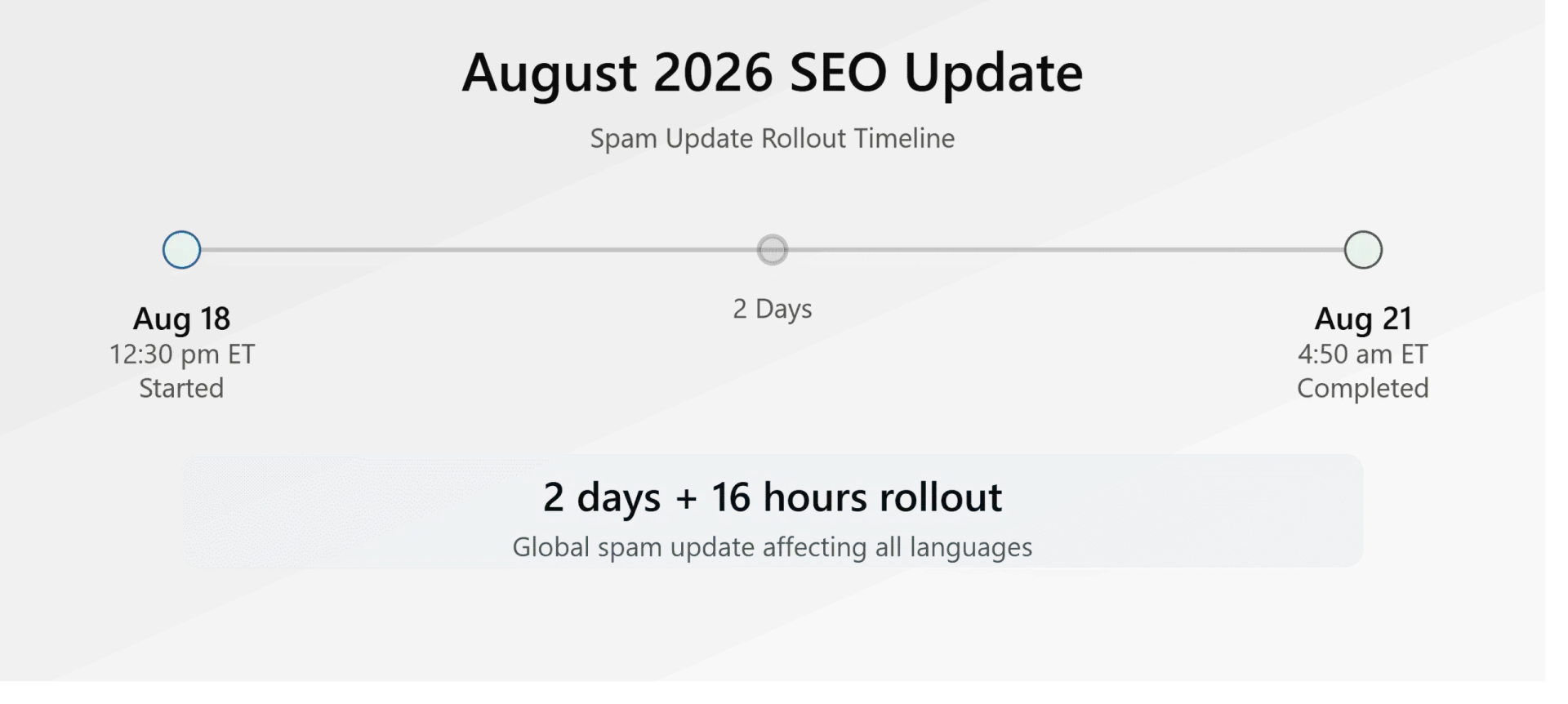
Google spam updates are becoming much quicker.
This is the key point that emerges following the August 2026 SEO core update which just concluded on August 21. In the last six months, I have seen three different spam updates from Google and each one of them gives us some clues about how the future of search looks like. The August spam update took only 2 days and 16 hours. Fast. If your website had seen any ranking changes recently, then knowing the reason behind them is the first step towards recovering from the issue. Let me give you the details of the latest Google spam update.
What Is the August 2026 Spam Update?
● Targets sites violating Google’s spam policies
● Does NOT target link spam or site reputation abuse
● Applies to all regions and languages
● Recovery can take months if you were hit
We are so back! Seems like the latest Spam Update fixed the false-positive issue. Thanks again, Barry, for the backup!
pic.twitter.com/3AmGm84ZPU— DonMendo (@donmend0)
August 20, 2026
How Fast Are These Updates Now?
This is when things get really exciting. Back in March 2026, Google rolled out an update to address spam within 19 hours and 30 minutes. This was the quickest confirmed release in the history of the Search Status Dashboard. The June 2026 update required 2 days and 1 hour while the August update took 2 days and 16 hours.
What does this mean? Google is iterating faster on spam filters. This fast release implies that Google is using automated processes for identifying and punishing spam patterns—presumably through machine learning algorithms based on the large dataset of their SERP. While this is great for legitimate publishers, it also means spam strategies expire quicker.
Real-World Impact: What SEOs Are Seeing
After each update, SEO forums burst into life. This is what happened after the conclusion of the August 21 update:
Several sites have had their false positive issues resolved. For example, @DonMendo shared in a Tweet an impressive recovery in rankings on August 18 with the comment: “We are so back! Seems like the latest Spam Update fixed the false-positive issue.” It seems that Google may have overreacted in a previous update and this one solved the problem.
On the contrary, several other websites have suffered from huge traffic loss. For example, one website owner wrote: “Traffic has been absolutely decimated. Analytics shows less than 100 visitors in a 30 minute time span. Discover and Google News completely dead.” Another site mentioned that niches were filled with spam where big resellers with thin content replaced specialists in these areas.
Also, some publishers have noticed the delay in the process of news indexing on Google News and Discover, which used to be completed in minutes but now takes several hours.
What You Should Check Right Now
If your traffic dropped this week, here’s your action plan:
● Check Google Search Console. Look at your Performance reports from before August 18 (baseline) and after August 21 (update complete). Focus on queries that dropped the most. Are they related to specific content types?
● Review Google’s spam policies. Visit developers.google.com/search/docs/essentials/spam-policies and read every policy category: cloaking, keyword stuffing, hidden text, scraped content, automated content, comment spam, etc. Does any of your site violate these?
● Audit your backlink profile. While this update doesn’t target link spam, low-quality or unnatural links can hurt your domain authority. Run an audit and disavow clearly spammy links.
● Check your content for thin, duplicate, or AI-generated issues. Google’s spam systems increasingly target low-value content. Make sure every page either solves a user problem or offers unique insight.
● Wait. Recovery takes months. Google’s own guidance says recovery can take several months because its automated systems need time to re-evaluate your site.
Why This Update Matters for GEO (Generative Engine Optimization)
You may know about GEO—this is using your content to achieve a placement on AI Overviews and AI search options. The following explains how: Spam updates by Google are getting better at filtering out content before it reaches the AI. If spam websites don’t get ranked on regular Google Search, then it’s impossible to feed their content to AI Overviews.
This implies that creating genuine and valuable content isn’t important just for SEO purposes but for AI as well. Websites which have passed the test usually have these characteristics in common: unique research or perspective, as well as evident E-E-A-T (Experience, Expertise, Authoritativeness, Trustworthiness) signals.
Looking Forward: What’s Next?
Google normally launches spam filters every 2-4 months. In 2018, we’ve witnessed these in March, June, and August—thus, there will be another one in October or November. The reduced launch time implies that Google is improving its algorithms. It’s a positive sign; it shows that spam strategies do not last long.
For SEOs and site owners, there is only one recommendation—to think about the future. Thin articles, scraped content, and links manipulations can only harm you from now on. Google’s system is too advanced to trick.
The Bottom Line
The spam update of August 2026 is proof that Google’s automation is becoming smarter than ever. The update required only 3 days for implementation globally and applied penalties to spam activity in all geographic locations and language areas. Some websites got help from the removal of false positives, while others were penalized.
In case your website was affected by the update, there is one clear direction – conduct an audit of your content according to the guidelines of Google’s spam policy, get rid of all low-quality, duplicate content and wait. It will take some time until recovery, but it is inevitable for sites that have solved the problem.
And in case you want to save your website from the future updates? Concentrate on authentic, expertly generated content. This is the only thing that Google’s algorithms always reward.
Common Questions About the August 2026 Update
Will my site recover automatically?
Not without action. If Google’s systems flagged your site as spam, you need to fix the underlying issue (remove the spam content, improve quality, etc.) and then wait for Google to re-crawl and re-evaluate. This can take weeks to months.
Does this update affect link spam?
No. Google has separate systems for detecting link spam. This update targets on-page content spam and related behaviors. If you have a link spam problem, you’ll need the December spam update or a manual link spam action to be affected.
How do I know if I was hit by this update?
Check Search Console. Compare your traffic (clicks, impressions, position) before August 18 and after August 21. If you see a sharp drop specifically during the rollout window, you were likely affected. Use tools like Semrush or Ahrefs to check if your competitors dropped too (industry-wide changes suggest a core algorithm update, not just you).