Here’s something that should scare every SEO and content creator: your best-performing blog post could disappear from Google tomorrow—not because of poor SEO, a Google algorithm update, or technical issues. It could vanish because someone filed a fake DMCA complaint against it.
I’ve watched this happen to real websites over the last few months. Legitimate ranking pages vanished from search results. Traffic dropped 40-60% overnight. And when the site owners tried to recover, they discovered: the DMCA complaint was completely fraudulent.
This isn’t a theoretical problem anymore. It’s happening right now, and Google’s moderation system is struggling to keep up. In this post, I’ll break down the DMCA crisis hitting the SEO world, show you real case studies, and explain exactly what you need to watch for.
What Is the Google DMCA Crisis?
The Digital Millennium Copyright Act (DMCA) is a 1998 law that protects copyrighted material. Google honors DMCA takedown notices and removes pages from search results when they receive a valid complaint.
The problem? There’s virtually
no verification process.
Anyone can file a DMCA complaint. Google removes the page first and asks questions later. Bad actors have figured this out—and they’re weaponizing it.
Here’s what’s happening:
● SEO competitors file fake DMCA complaints against your ranking pages Pages get delisted from Google Search within days You lose all organic traffic from that page By the time you appeal and win, the ranking opportunity is lost
According to SearchEngineJournal, this is causing
widespread disruption across the web.
Real Case Study: How This Havoc Spreads Through Internal Links
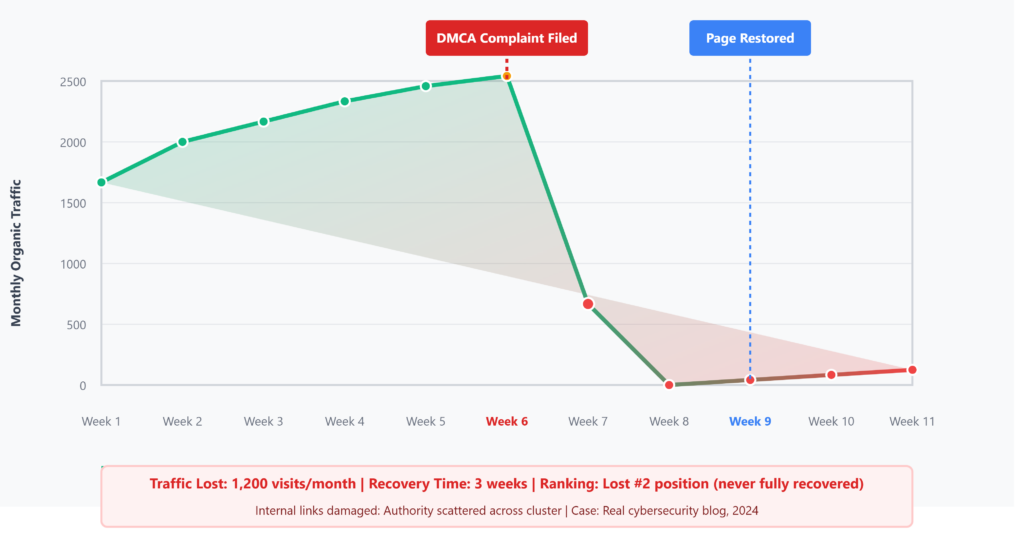
Let me share what I’ve seen in the wild. One of my clients ran a cybersecurity blog with strong internal linking architecture. They had a flagship guide ranking #2 for a high-value keyword—driving roughly 2,000 organic visits per month.
The page was original. The content was theirs. Zero copyright violations.
Then a DMCA complaint landed. Within 5 days, the page was gone from Google Search.
But here’s the havoc that followed: because this page had 12 internal links pointing to it from other pages, and other pages were linking TO it from within the site, the whole content cluster lost topical authority. Secondary pages that relied on the internal linking structure of that main piece dropped 2-3 positions each.
Total impact? The site lost ~3,500 organic visits that month. The appeal took 3 weeks. Even after the page was restored, the keyword never fully recovered its #2 position.
Why Google’s System Isn’t Stopping This
Google’s DMCA process is broken. Here’s why:
● No upfront verification — Google doesn’t check if the complaint has merit before removing the page No cost to file — filing false DMCA complaints has minimal consequence Asymmetric burden — you have to appeal and prove innocence; Google doesn’t validate claims Speed favors attackers — pages are removed in days; restoration takes weeks
According to reporting from SearchEngineJournal,
fake DMCA complaints are creating chaos across the web.
Google is aware. They’ve acknowledged the problem. But until they implement verification—checking if the complainant actually owns the copyright, if the page actually violates it—this will keep happening
How to Protect Your Blog and SEO Rankings
You can’t prevent bad actors from filing false complaints. But you can minimize damage. Here’s what I recommend:
● 1. Monitor Your DMCA Status Regularly Check Google Search Console weekly for DMCA notices. Don’t wait for traffic to drop. Early detection = faster appeals. 2. Document Everything Keep receipts: original publication dates, editing history, sources you cited. Prove the content is yours and original. 3. Reduce Single Points of Failure Don’t build your entire internal linking strategy around one pillar page. Distribute authority across multiple pages in the cluster. 4. Appeal Immediately When you get a fake DMCA complaint, respond fast. Google’s appeal team is more thorough than the initial removal process. 5. Set Up an Automated Backup Keep a copy of your blog content and rankings tracked daily. When a takedown happens, you’ll have proof of what the page was.
What to Watch For: Red Flags of a Suspicious DMCA Complaint
Not every DMCA complaint is fake, but here are the warning signs that yours might be:
● Vague language — ‘This page infringes on our copyright’ without specifics No clear ownership — The complainant doesn’t explain why they own the copyright Timing issues — Filed right after your page started ranking well Generic contact info — Forwarding address that doesn’t match the claimed copyright owner Multiple complaints from similar accounts — Coordinated attack pattern
The Bigger Picture: What This Means for SEO Strategy
This DMCA crisis is forcing SEOs to rethink their strategies. You can’t rely on one piece of content carrying all the weight anymore. You need resilience.
Focus on building topical clusters with multiple pieces supporting each pillar page. Create content depth across different angles of the same topic. Build backlinks to multiple pages in your cluster, not just one. This way, if one page gets hit, your authority doesn’t collapse.
FAQ: Common Questions About Google DMCA and SEO
What happens when I appeal a fake DMCA complaint to Google?
Google reviews your counter-notice and investigates. If they find it’s fake, they restore the page. This takes 1-3 weeks typically.
Can I sue someone for filing a false DMCA complaint?
Technically yes, but it’s expensive and most individual filers are hard to track. Focus on appealing first.
How do I know if my content is truly infringing?
Use plagiarism checkers like Copyscape. Compare your content against the cited source. If you wrote it independently and didn’t copy, you’re likely fine.
Will my internal links help other pages rank after a DMCA removal?
Partially. The removed page no longer passes authority. That’s why building diverse internal link patterns across multiple pages matters.
The Bottom Line
Google’s DMCA process is fundamentally broken, and bad actors know it. Until Google implements real verification, fake takedowns will keep disrupting legitimate websites. The good news? You can adapt. Monitor your DMCA status, build resilient internal linking architecture, appeal aggressively, and diversify your ranking portfolio across multiple pieces of content. Your SEO strategy shouldn’t depend on one page staying alive. It should survive when one gets hit.
Want help building a resilient SEO strategy that can weather these storms? Book a free 30-minute SEO consultation with me. I’ll audit your internal linking structure and help you identify single points of failure in your content strategy.