Anthropic has officially launched Claude Design, a dedicated AI-powered design capability built directly into the Claude ecosystem. For digital marketers and SEO professionals, this is not just another product update to scroll past. It marks a genuine shift in how brands can produce visual content at scale and it raises real questions about what that means for search rankings, human creativity, and Google’s content policies.
Whether you see Claude Design as a productivity miracle or a risk to your profession depends largely on how you use it. In this article, we break down what Claude Design actually does, examine its positive and negative repercussions, discuss its specific impact on SEO workflows, and answer the big question: does AI-generated design content comply with Google’s current policies?
What Is Claude Design? A Quick Primer
Claude Design is Anthropic’s answer to the growing demand for AI tools that go beyond text generation. Built on the same foundational model as Claude Sonnet and Opus, it can now interpret design briefs, generate on-brand visual assets, suggest layout compositions, and iterate on UI/UX mockups in real time.
Think of it as having a mid-level design assistant that never sleeps, understands brand guidelines in plain English, and can turn a 10-word brief into a structured visual concept within seconds. Unlike generic AI image generators, Claude Design focuses on purposeful, contextually relevant output — meaning it is less about art for art’s sake and more about conversion-driven, search-aligned visual content.
The Good: Why Claude Design Is a Genuine Opportunity
1. Faster Content Production at Scale
One of the most persistent bottlenecks in SEO content strategy is the gap between written content and supporting visuals. Articles need infographics. Landing pages need hero images. Blog posts need featured images that are relevant, not generic stock photos. Claude Design collapses the turnaround time for all of these from days to minutes.
For SEO teams managing high-volume editorial calendars, this is transformative. You can now brief, draft, and illustrate a 2,000-word pillar page in a single working session without waiting on a designer.
2. Better On-Page Engagement Metrics
Google’s Core Web Vitals and user engagement signals — including dwell time, scroll depth, and bounce rate — are known ranking factors. Visual content directly improves these metrics. When Claude Design helps you produce contextually relevant diagrams, comparison charts, and visual explainers that match your article’s search intent, visitors stay longer. That is a measurable SEO win.
3. Consistent Brand Visuals Across All Content
Brand consistency is a trust signal, both for users and for search engines assessing E-E-A-T (Experience, Expertise, Authoritativeness, and Trustworthiness). Claude Design allows SEO teams to define brand parameters once and apply them consistently across every visual asset, reducing the patchwork look that plagues many content-heavy websites.
4. Accessibility and Alt-Text Alignment
Because Claude understands context, it can help generate accurate, descriptive alt-text suggestions alongside any visual it creates. Proper alt-text is both an accessibility requirement and a low-key SEO lever that many teams still neglect. Having it built into the design workflow removes an extra manual step.
The Bad: Real Risks SEO Professionals Cannot Ignore
1. Generic Visuals Could Hurt Differentiation
When every competitor uses the same AI design tool with similar prompts, visual differentiation erodes fast. Organic search rewards content that feels unique and authoritative. If ten competing blog posts all feature Claude Design-generated infographics that look essentially alike, no one stands out. SEO gains from improved engagement could be cancelled out by a loss of brand distinctiveness.
2. Over-Reliance Can Degrade Content Quality
There is a real risk that teams use Claude Design as a shortcut rather than a supplement. Producing fifty visuals a week means nothing if none of them communicates a genuinely useful idea. Quantity over quality is the fastest way to train your audience and eventually Google to stop trusting your site. AI-generated design is a tool, not a strategy.
3. Copyright and Attribution Ambiguity
The legal landscape around AI-generated imagery remains unsettled in many jurisdictions. Publishing AI-generated design assets at scale without a clear internal review process could expose brands to copyright disputes, particularly as intellectual property laws catch up with generative AI capabilities. SEO professionals who publish without a content governance framework do so at their own legal risk.
4. Job Role Disruption
Let’s be direct. Claude Design does automate tasks that junior graphic designers, UI designers, and visual content creators currently perform manually. For SEO agencies, this could mean smaller creative teams and narrower outsourcing budgets. While it opens new efficiency gains, it also puts pressure on design professionals to upskill into AI oversight, prompt engineering, and creative direction roles.
How SEO Professionals Can Actually Use Claude Design
Here is where the conversation gets practical. Claude Design is most valuable when integrated into existing SEO workflows with intention. These are the highest-leverage use cases:
- Featured Image Production: Instead of sourcing stock photos that your competitors also use, generate original featured images that visually represent your article’s topic. This supports brand authority and reduces the chance of duplicate visual content across the web.
- Infographic Creation for Link Building: Long-form infographics that visualise data, statistics, or step-by-step processes are among the most linked-to content formats in SEO. Claude Design can dramatically lower the production cost of infographics, enabling link-bait strategies at a scale that was previously prohibitive for smaller teams.
- Visual FAQs and Schema-Ready Graphics: With structured data and FAQ schema increasingly valuable for featured snippets, creating clean, visual FAQs that pair with schema markup is a compelling Claude Design use case. Visually clear Q&A graphics improve dwell time and support your schema strategy simultaneously.
- A/B Testing Landing Page Visuals: SEO is not just about organic rankings — it also encompasses landing page optimisation for conversion. Claude Design makes it faster to generate multiple visual variants for A/B testing, helping teams identify which visual framing drives the best engagement signals.
- Social Amplification Assets: Social shares remain an indirect SEO signal. Using Claude Design to rapidly produce platform-sized visual assets for each new piece of content ensures every article has a shareable visual ready the moment it publishes.
The Impact on SEO Jobs: Evolution, Not Extinction
The question “will Claude Design replace SEO professionals?” is the wrong one. The more accurate question is: which SEO skill sets become more valuable, and which become commoditised?
Tasks that are commoditised by Claude Design include basic visual asset creation, resizing content for multiple platforms, producing template-based infographics, and generating first-draft UI mockups. These activities, which once required a dedicated designer or a significant freelance budget, can now be handled by a trained SEO specialist with strong prompt engineering skills.
Skills that become more valuable include creative direction and quality control over AI outputs, strategic visual content planning tied to search intent, understanding which visual formats earn links and shares in your niche, and integrating design outputs into a coherent E-E-A-T content strategy. The SEO professionals who invest in these capabilities now will find themselves leading AI-augmented teams rather than being displaced by them.
Will Google’s Policies Compromise AI-Generated Design Content?
This is the most important question in the room, and the honest answer is: it depends on how you use the tool.
Google’s Helpful Content System does not penalise AI-assisted content on principle. What it penalises is content created primarily to manipulate search rankings rather than to genuinely help users. This principle applies equally to written content and design assets. An infographic that simplifies a complex topic for real readers is helpful content. A visual stuffed with keyword-heavy text designed purely to appear in Google Image Search is manipulative content.
Google’s Search Quality Rater Guidelines explicitly evaluate E-E-A-T across a page’s full content experience — including its visual elements. AI-generated design that looks generic, lacks credibility markers, or feels disconnected from the article’s core expertise will negatively affect a page’s perceived trustworthiness, even if the written content is strong.
The clearer risk area is Google Discover and Google Image Search. These surfaces prioritise original, high-quality visuals. As AI-generated imagery proliferates, Google is likely to develop improved detection methods and potentially deprioritise content whose visual assets are indistinguishable from mass-produced AI output. Staying ahead of this means using Claude Design as a starting point and adding meaningful human creative input before publishing.
There is also the question of future policy updates. Google has updated its spam policies multiple times in response to AI content at scale. It is reasonable to expect similar updates targeting AI design content if low-quality visual spam becomes a widespread problem. The prudent SEO strategy is to treat Google’s current tolerance as conditional, not permanent.
Final Verdict: Powerful Tool, Requires Strategic Discipline
Claude Design is genuinely impressive, and for SEO professionals willing to integrate it thoughtfully, it offers real competitive advantages. Faster production, better visual engagement, and consistent branding are not trivial benefits in a landscape where content volume and quality both matter.
But the tool is only as good as the strategy behind it. Teams that treat Claude Design as a magic button will produce forgettable, undifferentiated content that neither users nor Google will reward. Teams that use it as an accelerator within a human-led creative process will produce more, publish faster, and maintain the quality signals that earn lasting rankings.
As for Google’s policies — they will evolve. They always do. The best protection is not to ask what you can get away with today, but to build content that would still be worth reading and worth ranking if every AI shortcut disappeared tomorrow.
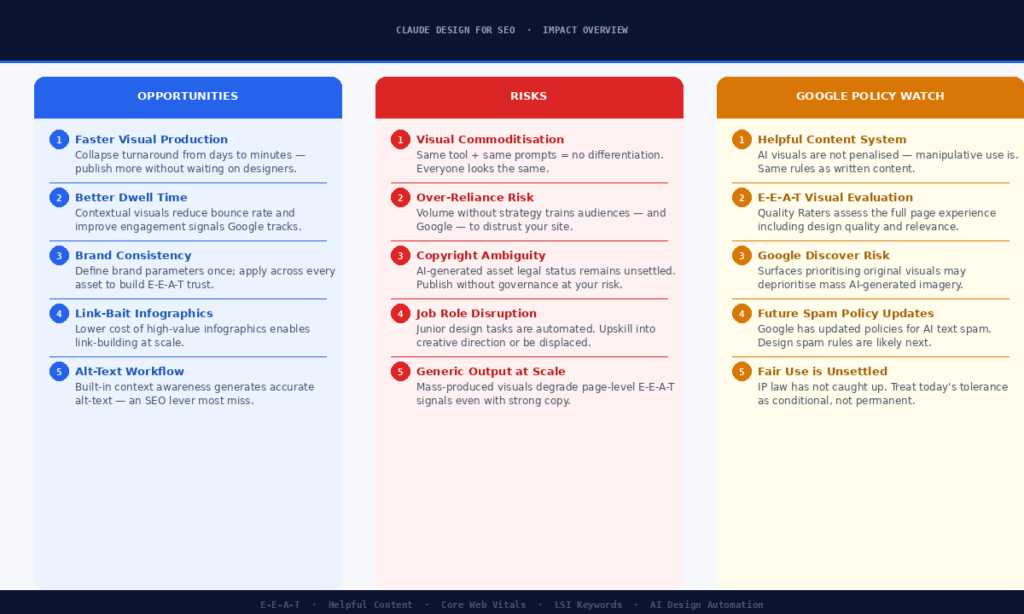
At a Glance: Claude Design for SEO
| Opportunity | Risk | Policy Watch |
| Faster visual production | Visual commoditisation | Helpful Content policy |
| Improved dwell time | Copyright ambiguity | E-E-A-T visual evaluation |
| Brand consistency at scale | Over-reliance risk | Future AI design spam rules |
| Alt-text workflow support | Job role disruption | Google Discover deprioritisation |
| Link-bait infographics | Generic output at scale | Search Quality Rater review |